
Introduction: Graphite Crucibles — Critical Components for Extreme High-Temperature Manufacturing
In the realm of modern high-end manufacturing, many critical processes rely on environments characterized by extreme heat. From traditional metal smelting to the production of third-generation semiconductor materials, the materials used within high-temperature equipment must not only withstand thermal environments reaching thousands of degrees Celsius but also maintain stable physical properties, excellent heat transfer capabilities, and a minimal risk of contamination.
Graphite crucibles emerged as a key class of high-temperature components precisely to meet these industrial demands.
Traditionally, graphite crucibles were primarily used to hold and transfer molten materials during the smelting of metals such as gold, silver, copper, and aluminum. However, with the rapid development of advanced manufacturing sectors—including the semiconductor industry, high-power electronics, and new energy materials—the applications of graphite crucibles have expanded far beyond traditional metallurgy.
Today, high-purity graphite crucibles have become essential components in:
- SiC single-crystal growth;
- Semiconductor crystal manufacturing;
- Photovoltaic silicon material preparation;
- High-temperature vacuum heat treatment;
- Thermal field systems for CVD and epitaxy equipment.
In semiconductor manufacturing, a graphite crucible is more than just a high-temperature container; it is a critical material within the thermal field system, with performance characteristics that directly influence crystal quality, temperature uniformity, and process stability.
What Is a Graphite Crucible?
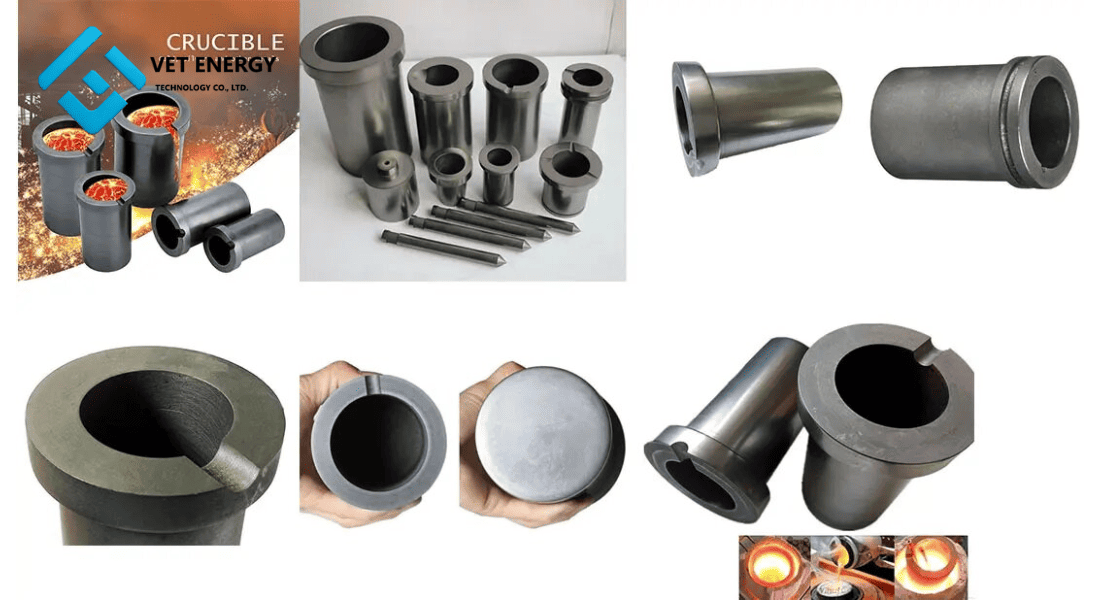
A graphite crucible is a high-temperature containment component machined from high-purity graphite; it is primarily used to hold, heat, or process various materials in extreme temperature environments.
Thanks to graphite’s unique thermal, electrical, and chemical properties, these crucibles can operate stably in environments where traditional metal materials would fail.
Currently, graphite crucibles are widely used in:
- Precious metal smelting;
- Non-ferrous metal casting;
- Alloy processing;
- High-temperature laboratory experiments;
- Semiconductor crystal growth;
- New energy material manufacturing.
In the field of high-end manufacturing, the primary value of graphite crucibles lies in their ability to provide a stable, clean, and highly uniform high-temperature environment. For instance, during silicon carbide (SiC) crystal growth, graphite crucibles must operate for extended periods in high-temperature environments exceeding 2,000°C while ensuring:
- Uniform heat transfer;
- Stable crystal growth;
- Minimal impurity contamination.
Consequently, high-purity graphite has become an indispensable core material.
|
Physical properties of isostatic graphite |
||
|
Property |
Unit |
Typical Value |
|
Bulk Density |
g/cm³ |
1.83 |
|
Hardness |
HSD |
58 |
|
Electrical Resistivity |
μΩ.m |
10 |
|
Flexural Strength |
MPa |
47 |
|
Compressive Strength |
MPa |
103 |
|
Tensile Strength |
MPa |
31 |
|
Young’ s Modulus |
GPa |
11.8 |
|
Thermal Expansion(CTE) |
10-6K-1 |
4.6 |
|
Thermal Conductivity |
W·m-1·K-1 |
130 |
|
Average Grain Size |
μm |
8-10 |
|
Porosity |
% |
10 |
|
Ash Content |
ppm |
≤5 (after purified) |
Why Is Graphite Ideal for High-Temperature Applications?
Graphite’s status as a vital material in high-temperature industries stems from its unique material structure.
Composed of carbon atoms arranged in a layered crystalline structure, graphite possesses exceptional thermal properties and chemical stability.
First, graphite exhibits outstanding high-temperature resistance. In vacuum or inert atmospheres, high-purity graphite can withstand extreme temperatures over long periods while maintaining structural integrity. This makes it highly suitable for ultra-high-temperature processes, such as semiconductor crystal growth.
Second, graphite offers excellent thermal conductivity. Temperature control is a critical factor affecting product quality during crystal manufacturing. Any localized temperature fluctuations can lead to:
- Increased crystal defects;
- Stress generation;
- Degraded material properties.
Graphite’s superior thermal conductivity helps equipment achieve a more uniform thermal field distribution, thereby enhancing process consistency.
Furthermore, graphite features a low coefficient of thermal expansion and excellent thermal shock resistance. High-temperature manufacturing often involves rapid heating and cooling cycles; graphite effectively mitigates structural damage caused by thermal stress, extending the service life of components.
At the same time, high-purity graphite demonstrates excellent chemical stability. In semiconductor manufacturing environments, material contamination is a major factor affecting product yield. By minimizing impurity content and optimizing material structure, high-purity graphite reduces process contamination and enhances crystal purity.
Manufacturing Process of High-Purity Graphite Crucibles
High-performance graphite crucibles are not merely the result of simple processing; they are manufactured through rigorous material preparation, high-temperature treatment, and precision machining.
The manufacturing process typically begins with the selection of high-purity graphite raw materials.
These raw materials generally include petroleum coke, pitch coke, and other high-purity carbon materials. For semiconductor applications, strict control is required over:
- Carbon purity;
- Metal impurity content;
- Grain size;
- Material density.
After the raw materials are crushed, ground, and sieved, they are mixed with a binder and then shaped into an initial crucible structure.
For high-end semiconductor applications, isostatic pressing technology is widely adopted because it yields more uniform material density and stable mechanical properties.
The formed crucible undergoes a baking process to enhance material strength and stabilize its internal structure.
Subsequently, a graphitization process transforms the disordered carbon structure into a highly ordered graphite crystal structure under ultra-high temperatures.
This process determines the final product’s:
- Thermal conductivity;
- Electrical resistivity;
- Mechanical strength;
- High-temperature stability.
Finally, depending on specific application requirements, the graphite crucible undergoes:
- CNC precision machining;
- Surface treatment;
- Dimensional inspection;
- Cleaning/purification treatment.
These steps ensure the crucible meets the high-precision and high-reliability requirements of semiconductor equipment.
Applications of Graphite Crucibles in Semiconductor Manufacturing
With the development of third-generation semiconductor technology, the importance of graphite crucibles in advanced manufacturing continues to grow.
1. Silicon carbide (SiC) crystal growth
As a third-generation semiconductor material, SiC offers advantages such as:
- High breakdown electric field;
- High thermal conductivity;
- High electron mobility;
…and is widely used in new energy vehicles, power electronics, and renewable energy systems.
Currently, industrial SiC crystal production primarily employs the Physical Vapor Transport (PVT) method.
2. PVT process
SiC powder sublimes in a high-temperature environment;
Gaseous silicon and carbon components migrate;
SiC crystals eventually form on the surface of a seed crystal.
The entire process requires precise control of:
- Temperature gradients;
- Thermal field distribution;
- Atmospheric conditions.
In this process, the graphite crucible plays critical roles, including:
- Holding the SiC raw material;
- Facilitating heat transfer;
- Stabilizing the thermal field.
3. Other processes
Beyond SiC crystal growth, graphite crucibles and related graphite components are also used in:
- Monocrystalline silicon manufacturing;
- Photovoltaic crystal growth;
- Semiconductor epitaxy equipment;
- High-temperature CVD processes.
In these applications, graphite materials help equipment maintain a more stable high-temperature environment, thereby improving product quality and production efficiency.
Conclusion: Graphite Crucibles Enable Next-Generation High-Temperature Manufacturing
From traditional metal smelting to advanced semiconductor crystal manufacturing, the evolution of graphite crucibles reflects the industrial sector’s ever-growing demand for high-performance materials.
For the semiconductor industry, graphite crucibles are more than just high-temperature resistant components; they are:
Critical engineering materials that ensure thermal zone stability, enhance crystal quality, and drive the advancement of manufacturing technology.
Leveraging extensive expertise in graphite material properties, high-temperature processes, and precision manufacturing, VET Energy remains committed to providing reliable, high-performance graphite material solutions to customers across the global semiconductor, new energy, and high-end manufacturing sectors.
Post time: Aug-10-2026