
Abstract
Isostatic graphite is a core functional material in carbon based thermal fields for CZ silicon, SiC PVT, semiconductor deposition, and high temperature furnaces. Rather than serving as the main insulation, it provides controlled heating or induction coupling, crucible support, gas flow guidance, electrode connection, and precision structures. This article explains how purity, strength, resistivity, thermal conductivity, expansion, porosity, machining, and coating compatibility should be matched to each component and validated under actual operating conditions.
1. System Role of Isostatic Graphite in Carbon Based Thermal Fields
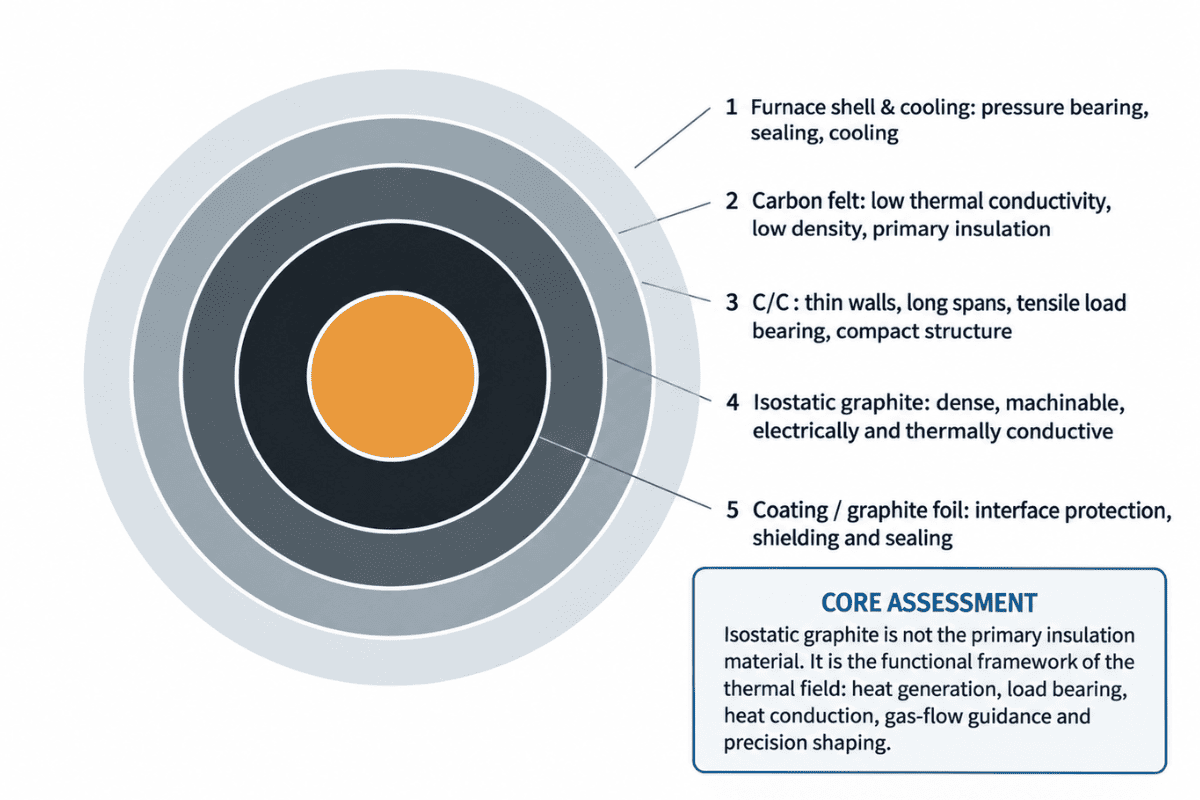
In a typical carbon based thermal field, isostatic graphite, carbon carbon composite (C/C), and carbon felt serve as dense functional parts, lightweight load bearing parts, and low conductivity insulation, respectively. Dense graphite typically has a thermal conductivity of about 70-150 W/(m·K), far above that of carbon felt. It is therefore well suited to spreading heat along a designed path and acting as a resistance heater or induction susceptor, but it should not replace large areas of insulation. C/C offers higher specific strength, good thermal shock resistance, and thin wall formability for long span structures, fasteners, hot face panels, and high temperature tensile loads. Soft felt or carbon bonded carbon fiber (CBCF) provides the primary insulation, while graphite foil and PyC, glassy carbon, SiC, or TaC coatings provide interface shielding, sealing, and chemical protection.
| Thermal Field Role | Primary Function | Key Metrics | Typical Failure Modes |
|
Resistance heater |
Convert electrical energy directly into heat |
Resistivity and temperature coefficient; cross section consistency; thermal conductivity; flexural strength; purity |
Hot spots; local sublimation; overheating at terminals |
|
Induction susceptor / crucible |
Couple electromagnetic energy and create temperature gradients |
Resistivity; wall thickness; skin depth; thermal conductivity; CTE; purity |
Circumferential nonuniformity; cracking; Si/C vapor corrosion |
|
Crucible support / base |
Carry the crucible and melt load |
Compressive and flexural strength; low porosity; SiO resistance; dimensional stability |
Support cracking; particle contamination; deformation |
|
Guide tube / heat shield |
Control radiation, gas flow, and axial gradients |
Low particle shedding; fine grain size; CTE; thermal conductivity; machining accuracy |
Dust; edge chipping; thermal field drift |
|
Tray / boat / fixture |
Support workpieces and transfer heat |
Flexural and compressive strength; thermal shock resistance; surface condition; material compatibility |
Warping; fracture; carburization or eutectic reaction |
|
Electrode / connector |
Carry high current and provide mechanical positioning |
Contact resistance; thread strength; oxidation protection; thermal expansion |
Arcing; contact heating; loosening |
|
Primary insulation |
Reduce heat loss |
Low density; low thermal conductivity; resilience or formability; low ash |
Usually provided by soft felt or CBCF |
Table 1 Function, Performance Metric, and Failure Mode Mapping for Isostatic Graphite Components
Optimizing a thermal field often creates tension between local and system level performance. A higher heater thermal conductivity may reduce local temperature differences while increasing axial heat loss. A denser crucible may resist porosity and erosion but add weight and thermal mass. A higher elastic modulus can improve dimensional stability yet raise thermal stress under the same constraint and temperature difference. Greater purity can reduce contamination but may also affect oxidation behavior and processing cost. Material selection should therefore combine component function, furnace power control, and the maintenance strategy.
2. Major Furnace Types and Component Applications
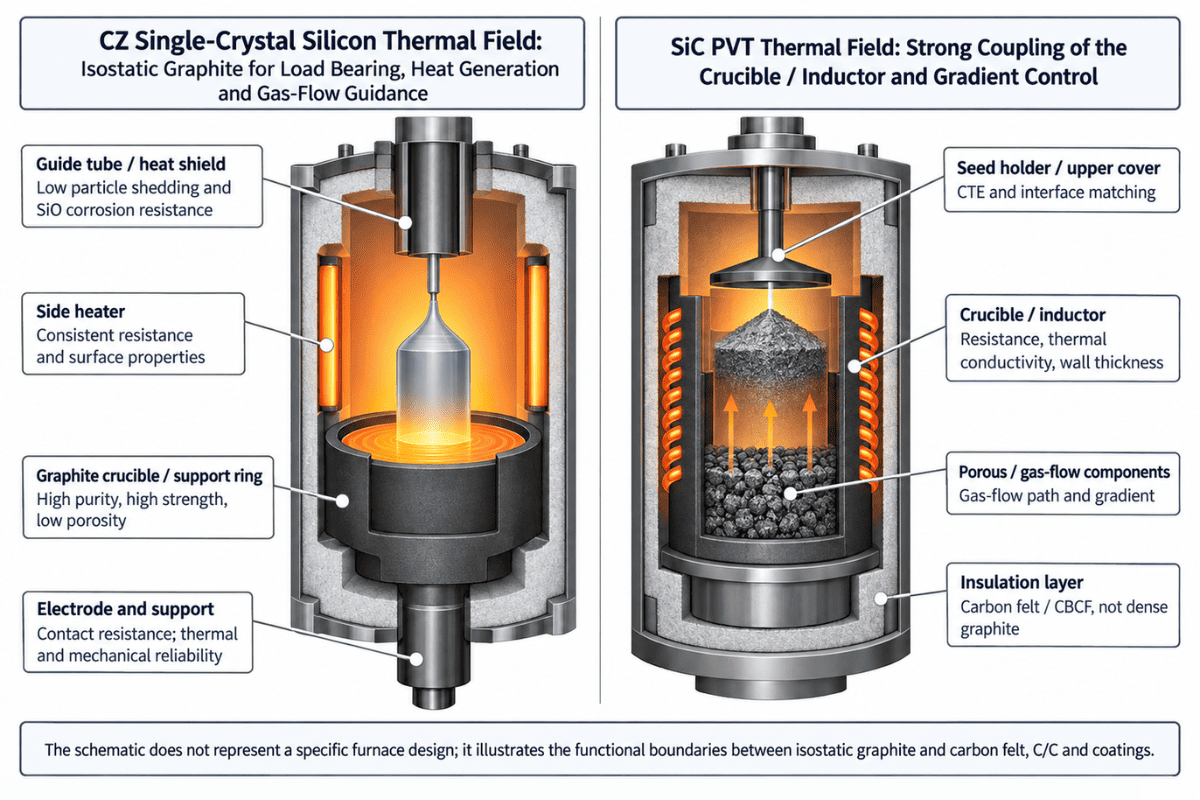
Figure 2 Isostatic Graphite Components in CZ Silicon and SiC PVT Thermal Fields
2.1 CZ Silicon Growth: Prioritizing High Purity, Low Particle Shedding, and SiO Resistance
In the Czochralski process, silicon is melted above approximately 1,400°C. A graphite crucible or support holds the quartz crucible, surrounded by heaters, heat shields, guide tubes, electrodes, and structural parts. The uniformity of isostatic graphite supports an axisymmetric thermal field, while high purity and low particle shedding help limit crystal contamination. SGL Carbon describes R6510 as an established choice for parts in direct contact with Si-O vapor, with emphasis on long service life and low particle release; R6650 targets more aggressive exposure to molten silicon or SiO vapor. Mersen supplies integrated graphite, insulation, and C/C systems for CZ furnaces, using grade 2124 for low porosity, high density support or induction components and grades 2020/1940 for heater families.
2.2 SiC PVT Growth: Coordinating Electromagnetic Coupling, Vapor Corrosion, and Temperature Gradients
SiC physical vapor transport (PVT) growth operates at low pressure and extreme temperatures of roughly 1,800-2,600°C; published sources report typical crystal growth zones above 2,400°C.[13,20] The graphite crucible serves as a container and may also act as an induction susceptor and a carbon source boundary. The seed holder, upper cover, gas flow components, and insulation openings jointly control gas flow, composition, and temperature gradients. Because a grade change alters resistivity, thermal conductivity, coefficient of thermal expansion (CTE), porosity, and surface reactions at the same time, PVT qualification should extend beyond a same size replacement followed by a simple power adjustment.
SGL Carbon lists R6510 for SiC crystal growth thermal fields and as a substrate for SiC coatings, R6710 as a high flexural strength grade with a 3 μm grain size, and R6810 as a high thermal conductivity grade. Mersen supplies isostatic graphite, porous graphite, TaC coatings, and CBCF insulation, and notes that porous graphite can help stabilize gas flow and radial temperature distribution. Toyo Tanso has also announced continued development of SiC and TaC coated products. These offerings reflect three complementary strategies: dense substrates for low particle shedding and structural life, high conductivity grades for reducing local gradients, and porous or coated components for controlling chemical boundaries and flow fields.
| Component | Key Parameters | Product Level Evaluation Metrics |
|
Crucible body |
High purity; uniform resistivity; appropriate thermal conductivity; low porosity or controlled permeability; long term dimensional stability |
Induction coupling efficiency; wall thickness to skin depth ratio; axial mass loss; crystal impurities |
|
Upper cover / seed holder |
CTE; flexural strength; coating compatibility; machining accuracy |
Temperature gradient; coating cracks or delamination; seed crystal thermal stress |
|
Gas flow / porous component |
Pore size distribution; permeability; purity; vapor phase stability |
Pressure drop; flow stability; radial crystal resistivity and defects |
|
Insulation cylinder / cover |
Low thermal conductivity; low ash; dimensional retention; usually CBCF or soft felt |
Heat loss; outer wall temperature; deformation after repeated furnace cycles |
|
Coating substrate |
Substrate CTE; surface porosity and roughness; coating thickness and defects |
Thermal cycling; pinholes; delamination; elemental diffusion across the section |
Table 2 Material, Component, and Crystal Evaluation Chain for SiC PVT Thermal Fields
2.3 Vacuum Heat Treatment, Sintering, MIM, and High Pressure Furnaces
In vacuum quenching, vacuum sintering, powder metallurgy, metal injection molding (MIM), brazing, and high pressure sintering furnaces, isostatic graphite is widely used for heaters, rails, trays, posts, partitions, muffles, heat shields, and electrodes. SGL Carbon combines dense graphite, C/C, soft felt, rigid felt, and graphite foil into complete high temperature furnace thermal fields. Ipsen engineering guidance notes that graphite thermal fields generally offer high energy efficiency and relatively low replacement costs, while all metal thermal fields may be preferable for processes that are sensitive to carbon dust, eutectic reactions, or carburization.
2.4 Polysilicon, Epitaxy, MOCVD, and ALD
Polysilicon CVD reactors require ultra high purity electrodes with low resistance and high strength to limit contact heating and contamination. Epitaxy, MOCVD, and ALD systems commonly use SiC or TaC coated isostatic graphite susceptors. The coating isolates substrate pores and particles and also improves durability against corrosive gases and in situ cleaning. Mersen publishes a UHP5 electrode route with less than 5 ppm impurities for polysilicon production and uses SiC or TaC coated components in epitaxy processes above 1,500°C. Toyo Tanso and SGL Carbon also identify CTE matching between the SiC coating and graphite substrate as a critical design factor.
Large ALD susceptors must deliver temperature uniformity, flatness, accurate pocket geometry, controlled surface roughness, and long cleaning life. A supplier’s large block capability becomes a real product advantage only when precision machining, purification, coating, and final dimensional inspection are all controlled. For components approaching or exceeding 1 m in diameter, block uniformity, clamping distortion during machining, the coating furnace working zone, and transport packaging should be managed as one project.
3. Comparison of Major Brands and Published Product Data
| Company / Brand | Published Product Portfolio | Grade or Capability Focus (Not a Ranking) | Main Applications |
|
Toyo Tanso |
IG, ISEM, ISO, HPG, purification, and SiC/PyC composite treatments |
IG-11 balanced grade; IG-15/45 high density and high conductivity; IG-56 large format |
CZ growth; industrial furnaces; semiconductors; nuclear energy; optical fiber |
|
SGL Carbon |
SIGRAFINE isostatic and porous graphite; SIGRATHERM felt; SIGRAFLEX foil; SiC coatings |
R6510 for low particle shedding and SiO/SiC thermal fields; R6650 high density; R6710 3 μm high strength; R6810 high conductivity |
CZ growth; SiC PVT; epitaxy; high temperature furnaces |
|
Mersen |
Isostatic and extruded graphite; CALCARB insulation; C/C; SiC/TaC coatings; porous SiC |
2020/1940 heaters; 2124 support and induction parts; UHP5 electrodes |
Integrated CZ, PVT, epitaxy, and ALD thermal field solutions |
|
Tokai Carbon |
G/HK fine grain graphite; purification; SiC coatings; precision machining |
Low CTE and thermal shock grades plus semiconductor equipment parts; published lead time of 6-8 months |
Semiconductors; solar; heat treatment; precision components |
|
IBIDEN |
Graphite Specialty (FGM) and a global precision machining network |
Published materials emphasize semiconductor single crystal production and stable supply |
Semiconductor single crystal processes |
|
Entegris POCO |
Uniform microstructure graphite with 1, 5, and 10 μm grain sizes plus post processing |
AXF-5Q, a 5 μm high strength precision machining grade, plus finer grain series |
Precision structures; semiconductors; advanced industrial applications |
|
VET Energy |
Isostatic graphite, C/C, and related finished products |
Precision machining, purification, and coatings for photovoltaic and semiconductor localization programs |
Expanding domestic capability from general photovoltaic materials to high reliability, high purity, and regulated applications |
Table 3 Representative Brands and Technology Portfolios
4. Local Sourcing, Supply Chain Control, and Total Cost of Ownership
The challenge of local sourcing has shifted from whether isostatic graphite can be produced to whether a specific application grade can be reproduced consistently with long term change control. Published studies indicate that selected domestically produced pitch coke can achieve strong production yields and compressive strength in the hundreds of MPa after scale up validation. VET Energy reports an established portfolio of isostatic graphite and C/C products serving photovoltaic, semiconductor, and nuclear energy applications. High end thermal field programs should still audit large block uniformity, trace elements, particle shedding, hot state resistance curves, coating compatibility, machining cleanliness, and batch consistency.
A substitution program should not be judged solely by the price per metric ton of a raw block. The cost of precision thermal field components depends on usable dimensions, machining yield, purification and coating, qualification time, inventory, service life, furnace downtime, and final product yield. A large block with poor internal uniformity may have a low quoted price but a lower usable yield and a higher total cost of ownership.
References
[1] He, C. Screening Experiments on Pitch Coke for Isostatic Graphite Production [J]. VET Energy, 2022(5): 88-91.
[2] Zhao, H. New Materials Industry Advances Through Innovation [J]. China Small and Medium Enterprises, 2022: 35-36.
[3] SGL Carbon. Our Specialty Graphites for the Semiconductor Industry [EB/OL]. 2024/2025.
[4] VET Energy. Our Specialty Graphites for High-Temperature Furnaces [EB/OL]. 2025.
[5] Toyo Tanso. Semiconductor Manufacturing Applications [EB/OL].
Post time: Sep-17-2026