
CVD coating focus rings play a critical role in modern semiconductor etching by stabilizing plasma boundaries and ensuring uniform ion distribution across the wafer. This article explains why they are essential for advanced nodes, highlighting their impact on etch uniformity, CD control, contamination reduction, and overall process yield.
Ⅰ. From Plasma Etching to Focused Ring Engineering
Plasma etching is one of the most critical patterning technologies in modern semiconductor manufacturing, enabling the creation of the nanoscale features required for advanced logic and memory devices. As technology nodes continue to shrink below 10 nanometers and device architectures evolve toward FinFET and Gate-All-Around (GAA) structures, the tolerance for process variations has narrowed dramatically. Today, parameters such as etch uniformity, critical dimension (CD) control, and defect density must be controlled with near-atomic precision.
While process optimization typically focuses on plasma chemistry, radio frequency (RF) power, and chamber design, an equally important—yet often less prominent—factor lies in the control of boundary conditions at the wafer edges. This is precisely where the focus ring plays a critical role. Located around the wafer on the electrostatic chuck (ESC), the focus ring acts as a boundary modifier, reshaping the local electric field, stabilizing the plasma sheath, and ensuring uniform ion distribution across the entire wafer surface.
In advanced etching environments, focus rings coated with chemical vapor deposition (CVD) have become the industry standard due to their superior material properties. These components are not merely consumables; they are precision-engineered surfaces that directly influence plasma behavior, process stability, and ultimately determine device yield.
Ⅱ. Why Focus Rings Are Critical in High-Precision Etching
In plasma etching systems, the wafer edges exhibit discontinuities in both geometry and electrical boundary conditions. Without proper compensation measures, this discontinuity leads to significant distortions in the electric field and plasma sheath, triggering the so-called “edge effect.” This effect manifests as non-uniform ion incidence angles and fluctuations in ion flux density, resulting in deviations in etch rates and etch profiles near the wafer edge.
Experimental and theoretical studies indicate that, in the absence of edge compensation structures, the region extending several millimeters inward from the wafer edge becomes an unusable edge zone¹. For advanced technology nodes, where chip sizes are large and process margins are extremely tight, such area loss is economically unacceptable.
The introduction of a focusing ring effectively extends the plasma boundary outward beyond the physical edge of the wafer, thereby creating a more uniform sheath structure. By providing a controlled electrical and physical environment, the focusing ring ensures that the trajectories of ions remain highly consistent across the entire wafer surface. This is critical for achieving the uniformity levels required by modern mass production; in such manufacturing environments, the target for in-wafer etch uniformity is typically set within a range of ±2%.
Furthermore, by stabilizing the boundary conditions of the chamber across different wafers, the focusing ring helps improve process repeatability. In high-throughput manufacturing environments, even minor fluctuations in edge conditions can lead to cumulative process drift; therefore, the stability of focus ring performance is particularly indispensable.
Ⅲ. The Core Value of CVD Coatings
As plasma etching processes become increasingly demanding—particularly with the widespread adoption of fluorine- and chlorine-based chemical processes—the material requirements for focus rings have also become more stringent. Traditional materials such as quartz or bulk ceramics often suffer from high etch rates, a tendency to generate particles, and poor stability under long-term plasma exposure. CVD coatings—particularly CVD SiC (silicon carbide) and CVD carbon coatings—effectively overcome these limitations thanks to their unique microstructure and chemical properties.
A key characteristic of CVD coatings is their extremely high density, which is close to the theoretical density, and their extremely low porosity, which greatly enhances their resistance to plasma-induced etching. Studies have shown② that in a fluorine-based plasma environment, the etch rate of CVD SiC is only a fraction of that of quartz, making it an ideal material for long-duration, high-power etching processes. This increased durability directly translates to longer component lifespans and reduced maintenance frequency.
Equally important is the issue of contamination control. Particles generated by chamber components remain one of the primary causes of yield loss in advanced semiconductor manufacturing processes. According to SEMI standards and relevant contamination control studies, even sub-micron particles can cause critical defects, particularly in advanced process nodes below 10 nanometers. CVD coatings, with their dense and stable surface properties, significantly reduce the risk of surface micro-spalling and impurity release, thereby helping to create a cleaner process environment and improve yield.
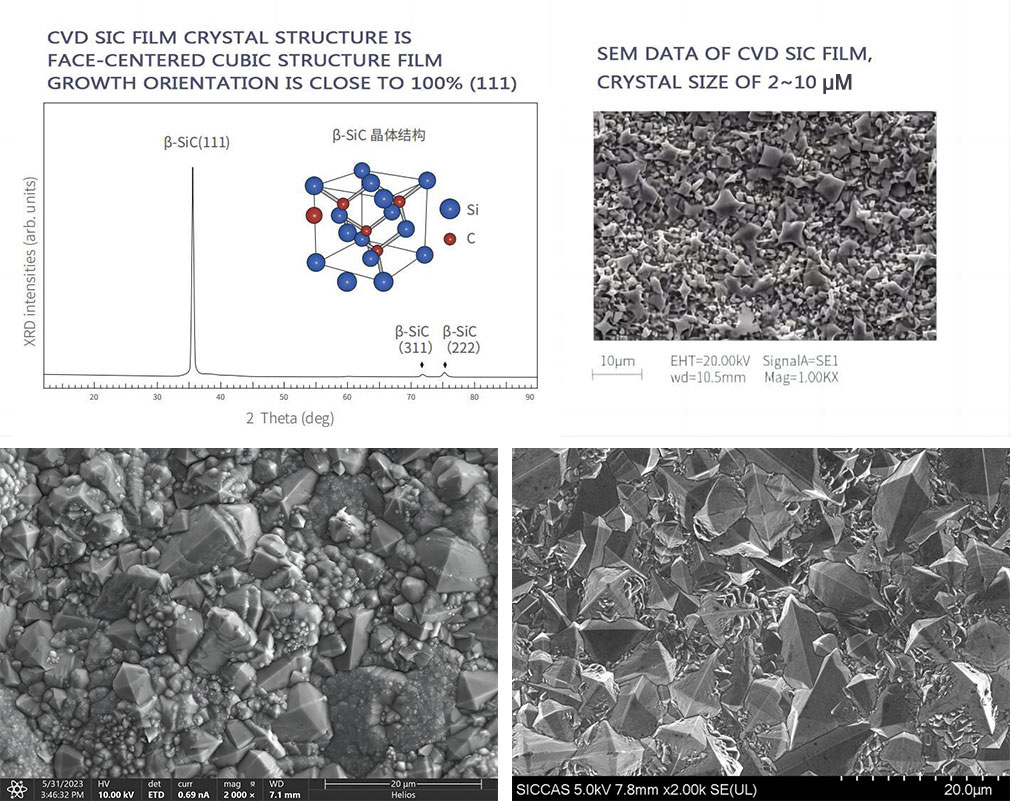
CVD SiC Film Crystal and Micro Structure
Another critical aspect is the control of secondary electron emission (SEE). The interaction between the plasma and the chamber surface is strongly influenced by SEE characteristics, which in turn affect plasma density and stability. Compared to traditional materials, CVD-coated surfaces exhibit more consistent and predictable SEE characteristics, enabling more precise control of plasma conditions and improving process repeatability.
Thermal stability is another key advantage of CVD coatings. High-density plasma processes often generate significant thermal loads, particularly in the wafer edge regions. Materials such as CVD SiC possess excellent thermal conductivity and controllable thermal expansion properties, effectively reducing the risk of cracking, warping, or delamination under cyclic thermal stress. This structural integrity is critical for ensuring consistent performance throughout extended process cycles.
Ⅳ. Impact on Key Etching Performance Metrics
Integrated CVD Coating Focus Ring
This focus ring will have a direct and quantifiable impact on multiple key performance metrics in semiconductor etching processes. One of the most critical metrics is etch uniformity. By stabilizing the plasma sheath and ensuring uniform ion flux distribution, CVD-coated focusing rings enable strict control over wafer-wide uniformity, often achieving the ±2% precision required for advanced device manufacturing. This level of control is particularly critical for high aspect ratio etching processes, where even minor deviations can lead to severe etch profile distortion.
Critical Dimension (CD) Control
Fluctuations in ion incidence angles at the wafer edges can cause CD deviations, and this issue becomes increasingly challenging as feature sizes continue to shrink. By maintaining consistent electric field conditions, the focusing ring helps ensure uniformity in ion trajectories, thereby reducing CD fluctuations across the entire wafer. This is critical for maintaining device performance and meeting design specifications at advanced process nodes.
Enhancing Process Repeatability and Stability
CVD coatings provide a stable and durable surface whose properties remain consistent over time, thereby reducing plasma condition drift and enabling more consistent performance across wafers. In high-volume manufacturing environments, this is critical for implementing Statistical Process Control (SPC).
Enhanced Particle Control Performance
Reduced wear and improved surface integrity minimize particle generation, which directly impacts yield and device reliability. In advanced semiconductor manufacturing, where defect density control targets are extremely stringent, this advantage alone is sufficient to justify the adoption of CVD-coated components.
As the semiconductor industry’s demands for process control precision and material performance continue to rise, the development and supply of CVD-coated focus rings are increasingly concentrated among a select few specialized, technology-driven manufacturers. Companies such as Hexcarbon, Vetek Semiconductor, and Semicera have established a solid market position in this field through their advanced CVD coating technologies, high-purity material processing capabilities, and deep integration with semiconductor equipment requirements. Specifically, companies like Vetek and Semicera focus on providing customized engineering solutions, tailoring focus ring designs to specific etch chemistry formulations and equipment platforms; while Hexcarbon has built a strong market reputation based on its expertise in high-purity graphite and coated components for semiconductor applications. This combination of materials science expertise and process technology know-how enables these companies to meet the increasingly stringent demands of next-generation semiconductor manufacturing.
References:
《Principles of Plasma Discharges and Materials Processing》
《Journal of Vacuum Science & Technology A》
Post time: Mar-20-2026