
In modern industrial systems, reliability, efficiency and pollution control are of utmost importance, and mechanical sealing technology plays a fundamental role. From chemical processing plants to semiconductor manufacturing facilities, the normal operating time of equipment often depends on a small but crucial component – the performance of mechanical seals.
As industrial processes become increasingly advanced and requirements rise, traditional sealing methods (such as packing seals) have gradually been replaced by mechanical seals. The driving force behind this transformation stems from the following needs:
● Higher work pressure
● Better leakage control
● Longer service life
● Compatibility with corrosive chemicals
● Higher energy efficiency
During this development process, materials science played a decisive role. Among all sealing materials, carbon-based composite materials – especially carbon graphite – have become a key driving force for high-performance sealing systems in the chemical, petrochemical and semiconductor industries.
What is a carbon-graphite mechanical seal?
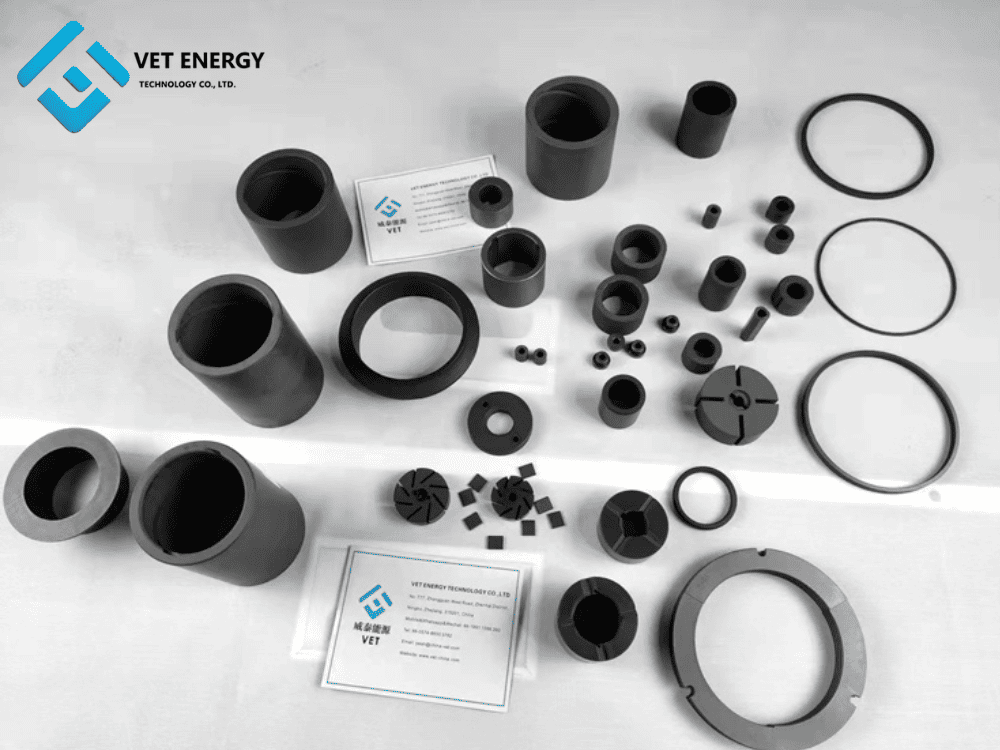
Carbon graphite mechanical seals are precision-designed sealing components, typically used in rotating equipment such as pumps, compressors, and mixers. They consist of fixed or rotating sealing rings made of carbon graphite base materials.
These sealing rings are used in conjunction with hard dual materials (such as silicon carbide or ceramics), forming a controllable sealing interface that prevents fluid or gas leakage while allowing rotational movement.
The key function of carbon graphite seals is to maintain a thin layer of lubricating film between the two surfaces, thereby ensuring:
● Minimum friction
● Controllable wear
● Maintaining stable sealing performance over a long operating period
Why is carbon graphite the preferred material for mechanical seals
Carbon graphite is widely used in mechanical sealing systems due to its unique physical and tribological properties. Unlike metals or ceramic materials, carbon graphite possesses inherent lubricity and can maintain stable performance under both dry and wet operating conditions.
Main physical properties:
✔ Low friction coefficient: 0.05 ~0.15
✔ Self-lubricating property: Layered graphite crystal structure
✔ Thermal stability: Up to 200–450°C (standard grade), higher for special grades
✔ Chemical resistance: Excellent resistance to acids, alkalis and organic solvents
✔ Compressive strength: Usually 80–200 MPa (depending on the impregnation type)
✔ Density: 1.6 ~2.1 g/cm³
✔ PV limit (pressure × velocity): 10–200 bar·m/s (depending on the grade)
These characteristics make carbon graphite particularly suitable for harsh sealing environments, where traditional materials would fail due to wear, corrosion or thermal degradation.
The self-lubricating property of graphite is particularly important. Its layered atomic structure makes it easy to shear the layers, thereby significantly reducing friction and wear during operation.
Common material systems for carbon graphite seals
Carbon graphite mechanical seals are not a single material, but a series of engineered composite materials. The most commonly used system includes:
Resin-impregnated carbon graphite: Suitable for general industrial applications. It has excellent self-lubricating properties and offers good cost-effectiveness.
Antimony-doped carbon graphite: It has higher thermal conductivity and mechanical strength, and is suitable for high-speed or high-load pumps.
Metal impregnated carbon graphite (copper, silver, etc.): Designed specifically for extreme conditions where enhanced heat dissipation and structural stability are required.
Each system has been optimized for specific operating conditions (such as temperature, pressure, chemical compatibility and rotational speed).
Applications in the semiconductor industry
Although mechanical seals are not directly part of the wafer processing equipment, they play a crucial role in the semiconductor manufacturing infrastructure.
Carbon graphite mechanical seals are widely used in:
● Dry vacuum pump
● Chemical delivery system (HF, HCl, H₂SO₄, etc.)
● CMP slurry delivery system
● Ultra-pure water (UPW) system
● Wet process equipment
In these systems, the sealing reliability directly affects the normal operation time of the wafer factory and the pollution control. Even a slight leakage or particle generation can lead to serious process disruptions or yield losses.
Therefore, carbon-graphite seals are regarded as a crucial component in the semiconductor manufacturing ecosystem, as they are essential for ensuring reliability.
Carbon Graphite Mechanical Seals and Semiconductor Graphite
Although both of these materials are based on carbon, their design concepts and performance requirements are completely different.
Carbon graphite mechanical seal:
● Focuses on tribology (friction, wear, lubrication)
● Optimized for dynamic motion and sealing interfaces
● Moderate purity requirements are met
● Specifically designed for chemical and mechanical durability
Semiconductor graphite components:
● Focuses on ultra-high purity and particle control
● Used in high-temperature process chambers (CVD, MOCVD, EPI)
● Requires SiC/PyC coating or ultra-high purity graphite
● Designed for thermal field stability rather than friction control
In summary, mechanical seal graphite is specifically designed for motion and sealing, while semiconductor graphite is specifically designed for thermal stability and process stability.
VET Energy’s Carbon Graphite Mechanical Seal Solution
Ningbo VET Energy Technology Co., Ltd combines advanced carbon material engineering with precise processing capabilities to provide high-performance carbon graphite mechanical seal solutions for global industrial applications.
Our manufacturing capabilities include:
● High-precision CNC machining for sealing end faces
● Resin, metal and antimony impregnation technology
● Optimized controllable porosity and density
● Surface finishing with ultra-low leakage performance
● Customized geometric design based on OEM requirements
With years of experience in the application of advanced carbon materials and industrial graphite, VET Energy provides support to customers in industries such as chemical, energy systems, water treatment and semiconductor facility infrastructure.
Carbon graphite mechanical seals are the core technology of modern rotating equipment, featuring excellent properties such as self-lubrication, chemical corrosion resistance, and thermal stability. They are applied in various industries, including chemical engineering, energy systems, and semiconductor manufacturing infrastructure.
As industrial systems continue to evolve towards higher efficiency and stricter reliability requirements, carbon graphite materials will remain a key driving force for the innovation of sealing technologies.
Post time: Jun-17-2026