
As semiconductor manufacturing processes continue to evolve toward larger wafer sizes, stricter thermal budgets, and lower defect tolerances, the materials used inside high-temperature process equipment have become increasingly critical. Among these key consumables and structural components, silicon carbide (SiC) ceramic wafer boats have emerged as one of the most important enabling technologies in modern diffusion and oxidation furnace systems.
In advanced semiconductor manufacturing environments, they directly influence thermal uniformity, particle generation, wafer stress distribution, process stability, and ultimately, device yield.
Particularly in 300mm wafer manufacturing, power semiconductor manufacturing, and third-generation semiconductor production, silicon carbide ceramic wafer boats are rapidly replacing traditional quartz-based carrier systems due to their superior thermal and mechanical properties.
What is a silicon carbide ceramic wafer boat?
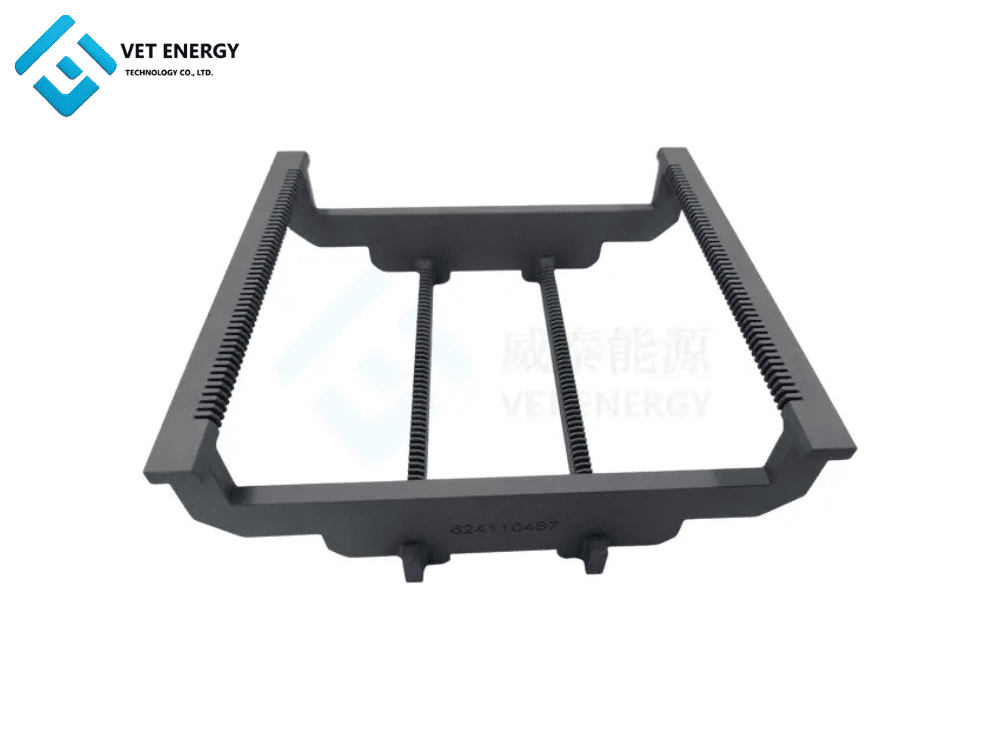
A silicon carbide ceramic wafer boat is a high-temperature wafer-carrying structure made of advanced silicon carbide-based ceramics. Its primary purpose is to safely support and transport multiple semiconductor wafers through vertical or horizontal furnace systems during heat treatment operations.
A typical wafer boat contains multiple precision-engineered wafer slots designed to maintain highly controlled wafer spacing during processing. Depending on the application, the structure may also include support beams, cantilever arms, airflow-optimized geometries, and lightweight reinforcement sections designed to minimize thermal mass.
In semiconductor furnace systems, wafer boats effectively serve as the interface between the wafers and the thermal processing environment. As device dimensions continue to shrink toward advanced technology nodes, even microscopic instabilities within the wafer support structure can affect process repeatability and defect performance.
This is one of the reasons why advanced furnace manufacturers are increasingly adopting high-purity silicon carbide ceramic components instead of traditional fused quartz systems.
The Roles in Diffusion and Oxidation Furnace Systems
Diffusion and oxidation remain among the most fundamental thermal processes in semiconductor manufacturing. These processes are widely used for dopant activation, thermal oxide growth, annealing, drive-in diffusion, and dielectric formation.
Typical operating temperatures range from approximately 900°C to 1200°C depending on process chemistry and device requirements. In some advanced power semiconductor or SiC device applications, thermal cycles may exceed 1300°C.
Under these conditions, the wafer boat must maintain dimensional stability over extended thermal cycles while minimizing contamination and preserving uniform wafer spacing.
Traditional quartz wafer boats have long been used in diffusion furnaces because of their high purity and relatively low cost. However, quartz materials exhibit relatively low thermal conductivity — typically around 1.4 W/m·K at room temperature.
By comparison, silicon carbide ceramics typically exhibit thermal conductivity values ranging from approximately 120 ~ 200 W/m·K depending on grade and microstructure.
This dramatic difference significantly improves temperature uniformity throughout the furnace load.
Higher thermal conductivity enables:
● More uniform wafer heating
● Reduced thermal gradients
● Improved wafer-to-wafer consistency
● Lower thermal stress accumulation
● Reduced edge effects during oxidation or diffusion
In advanced semiconductor manufacturing, where process windows continue narrowing, these improvements directly influence film uniformity and electrical performance consistency.
SiC wafer boats also provide substantially higher mechanical rigidity compared with quartz structures. This becomes increasingly important in vertical furnace systems processing large batches of 300 mm wafers, where boat length and mechanical loading can become significant.
Reduced deformation helps preserve precise wafer spacing and stable gas flow behavior throughout the thermal cycle.
Key Physical Properties of Silicon Carbide Ceramic Wafer Boats
The growing popularity of silicon carbide wafer boats is primarily due to the unique combination of thermal, mechanical, and chemical properties of silicon carbide ceramics.
Key Physical Characteristics
|
Property |
Typical SiC Performance |
|
Maximum operating temperature |
>1400°C in oxidizing environments |
|
Thermal conductivity |
~120–200 W/m·K |
|
Density |
~3.0–3.2 g/cm³ |
|
Mohs hardness |
~9.2 |
|
Elastic modulus |
~410 GPa |
|
Thermal shock resistance |
Excellent |
|
Chemical resistance |
High resistance to acids, alkalis, and process gases |
|
Mechanical rigidity |
Very high |
|
Particle generation tendency |
Low with optimized surface finishing |
These properties enable silicon carbide ceramic structures to maintain dimensional stability under prolonged thermal cycling, whereas traditional quartz components may begin to soften or deform.
The high stiffness of silicon carbide also reduces vibration and mechanical instability during the loading and unloading of wafers in the furnace.
Major Material Types for Silicon Carbide Wafer Boats
Modern silicon carbide wafer boats are manufactured using a variety of different material technologies, each optimized for specific process environments and cost-effectiveness requirements.
Recrystallized silicon carbide (RSiC) is widely used in high-temperature furnace applications due to its excellent purity and thermal stability. The manufacturing process for RSiC does not require the addition of significant amounts of sintering aids, which helps minimize the risk of contamination in semiconductor environments.
Reaction-sintered silicon carbide (RBSC or RBSiC) offers higher mechanical strength and lower manufacturing costs. However, residual free silicon in the structure may reduce its corrosion resistance in certain corrosive process environments.
For advanced semiconductor applications, CVD silicon carbide-coated graphite systems are becoming increasingly common. In these structures, the graphite substrate provides lightweight mechanical support, while the high-purity chemical vapor deposition (CVD) silicon carbide coating forms the process interface.
CVD silicon carbide coatings feature extremely low particle generation rates and exceptional purity, making them highly attractive for advanced logic and power semiconductor manufacturing. However, coating integrity and mismatched coefficients of thermal expansion must be carefully controlled to prevent cracking or delamination during repeated thermal cycling.
Common Process Challenges
Despite the performance advantages of silicon carbide ceramic wafer boats, they still face numerous engineering challenges in actual semiconductor manufacturing environments.
Particle contamination remains one of the most critical issues. As device sizes shrink, yield losses caused by particles are becoming increasingly severe. Even submicron-sized debris resulting from microcracks, coating delamination, or surface degradation can cause fatal defects on advanced wafers.
Thermal stress cracking is another long-standing challenge. Although silicon carbide possesses excellent thermal stability, it remains a relatively brittle ceramic material. Rapid heating or localized temperature non-uniformity can lead to cracks at structural corners, wafer grooves, or beam intersections.
Long-term thermal cycling can also lead to gradual deformation or creep, particularly in large-size wafer boats used in vertical furnace systems. Even minor geometric changes can alter wafer spacing and gas flow uniformity, thereby affecting oxide thickness control and dopant distribution consistency.
CVD coating delamination is another critical reliability issue in coated SiC systems. Because the graphite substrate and the SiC coating exhibit different thermal expansion behaviors, repeated high-temperature cycling eventually leads to stress accumulation at the interface.
Conclusion
In semiconductor diffusion and oxidation furnace systems, silicon carbide ceramic wafer boats play a critical role in maintaining thermal stability, controlling contamination, and ensuring process uniformity under extremely harsh operating conditions. Their high thermal conductivity, excellent mechanical rigidity, high-temperature resistance, and chemical stability make them increasingly indispensable in advanced semiconductor manufacturing.
As semiconductor process technologies continue to evolve, becoming increasingly complex, and defect control requirements grow ever stricter, the importance of advanced ceramic wafer carrier systems will only continue to rise. In modern fabs, many challenges related to particle control, thermal uniformity, and reliability can ultimately be traced back to the interplay between thermal cycling behavior, material stability, and the design of the wafer carrier system.
Consequently, silicon carbide ceramic wafer boats are rapidly evolving from auxiliary furnace hardware into critical components for next-generation semiconductor manufacturing.
Post time: May-28-2026