
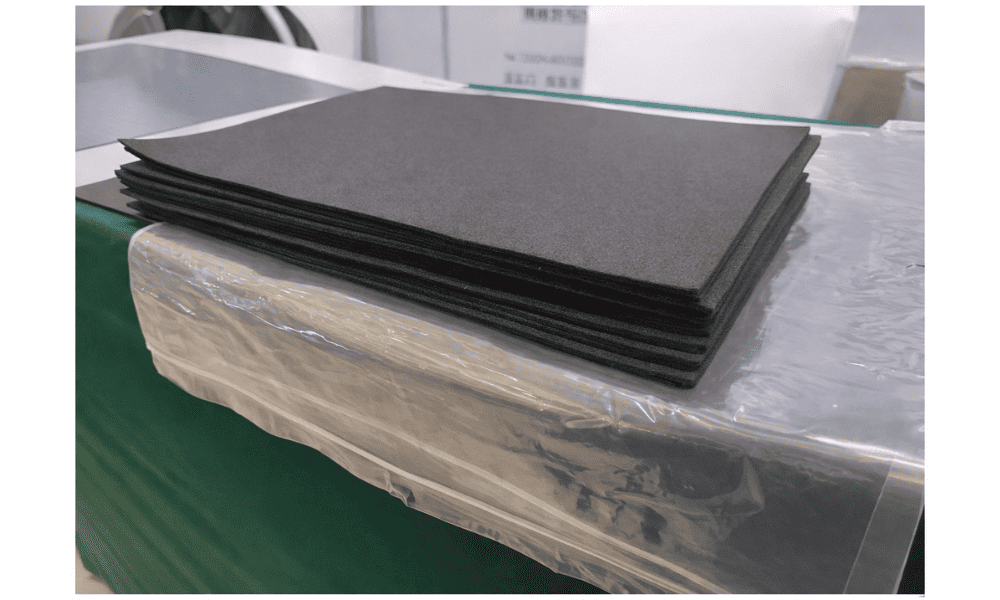
Graphite battery felt plays a crucial role in modern battery technologies, especially in flow batteries and fuel cells. As an efficient and durable material, graphite felt provides excellent electrical conductivity and thermal stability, while also contributing to improved battery performance, extended lifespan, and enhanced safety. In the application of flow batteries and fuel cells, the unique properties of graphite battery felt make it a key component in these high-efficiency energy storage systems.
The Application of Graphite Battery Felt in Flow Batteries
Flow batteries, particularly vanadium redox flow batteries (VRFB) and zinc-bromine flow batteries, are widely researched and applied in energy storage technologies. They store and discharge energy through active substances dissolved in the electrolyte, which gives them longer lifespans and larger energy storage capacities compared to traditional batteries. In the design of these batteries, graphite battery felt is typically used in the electrode parts, especially where the flowing electrolyte interacts with the electrode materials.
The high conductivity of graphite felt is the primary advantage in its application in flow batteries. In flow batteries, the electrochemical reaction takes place between the electrolyte and the electrodes, so the conductivity of the electrodes is critical to the battery’s performance. As an electrode material, graphite felt can effectively promote the movement of ions in the electrolyte and ensure efficient electron transfer, which improves the battery’s charge and discharge efficiency.
Additionally, graphite felt plays a significant role in thermal management within flow batteries. During the operation of flow batteries, internal heat is generated. The excellent thermal conductivity of graphite felt helps dissipate this heat, preventing the battery from overheating and ensuring it operates within the optimal temperature range. This thermal management capability not only helps extend the battery’s lifespan but also enhances its safety, reducing the risk of battery failure due to excessive heat.
The Application of Graphite Battery Felt in Fuel Cells
Fuel cells are devices that directly convert chemical energy into electrical energy through electrochemical reactions, widely used in electric vehicles, backup power supplies, and renewable energy systems. The application of graphite battery felt in fuel cells primarily lies in its role as a gas diffusion layer (GDL) and electrode material. Its importance is especially evident in proton exchange membrane fuel cells (PEMFC).
In fuel cells, graphite felt serves as the gas diffusion layer (GDL), responsible for evenly distributing reactant gases such as hydrogen and oxygen to the electrode surfaces, while also serving as a conductive medium. Due to its excellent conductivity, graphite felt can effectively transfer the electrons generated inside the cell to the external circuit, enabling the output of electrical energy. Its porous structure also facilitates gas diffusion and electrolyte conduction, ensuring that the electrochemical reactions in fuel cells proceed efficiently.
The graphite felt in fuel cells not only needs to provide good electrical conductivity, but it must also have excellent corrosion resistance and high-temperature performance. Since fuel cells operate in high-temperature and corrosive environments, the chemical stability and thermal stability of graphite felt make it an ideal choice. It can work stably in extreme conditions over extended periods, avoiding performance degradation due to material aging or corrosion.
Furthermore, graphite felt in fuel cells also helps optimize reaction efficiency through its well-designed structure. The arrangement and layering of graphite fibers not only enhance its mechanical strength but also improve gas flow efficiency. By precisely adjusting the porosity and structural form of graphite felt, the output power and performance of fuel cells can be further improved.
Future Development of Graphite Battery Felt
As flow battery and fuel cell technologies continue to evolve, the application prospects of graphite battery felt are expanding. Researchers are exploring ways to further enhance the performance of graphite battery felt through graphite composites, doping techniques, and surface treatments. For instance, improving the structural design of graphite battery felt can increase its conductivity, enhance its corrosion resistance, and improve thermal management capabilities. These improvements will further advance the application of flow batteries and fuel cells in high-performance energy storage and conversion fields.
In conclusion, the application of graphite battery felt in flow batteries and fuel cells, with its excellent conductivity, thermal management capabilities, and structural stability, has become a core material for these advanced energy storage and conversion systems. As energy technologies continue to develop, graphite battery felt will play an increasingly important role in driving battery technology innovation, improving energy efficiency, and advancing sustainable development.
Post time: Dec-23-2025