
In modern semiconductor manufacturing, thermal management is one of the most influential factors affecting crystal quality, epitaxial uniformity, and overall process stability. Whether producing monocrystalline silicon wafers, growing silicon carbide (SiC) crystals, or depositing compound semiconductor films, maintaining a highly controlled thermal environment is essential for achieving consistent material properties and high production yields.
At the center of these high-temperature systems is the High Purity Graphite Heater. Although often hidden inside crystal growth furnaces or deposition reactors, this component serves as the primary heat source and an integral part of the thermal field. Its material purity, structural design, and long-term stability directly influence temperature distribution, energy efficiency, and equipment reliability. As semiconductor manufacturing continues to move toward larger wafers, wider bandgap materials, and increasingly demanding process windows, graphite heater technology has become a key enabling factor in advanced thermal processing.
Material Characteristics
Unlike conventional metallic heating elements, High Purity Graphite Heaters combine excellent electrical conductivity with outstanding thermal performance under extreme temperatures. Manufactured from fine-grain isostatic graphite and purified to semiconductor-grade standards, these heaters typically contain only trace levels of metallic impurities, significantly reducing the risk of contamination during crystal growth and wafer processing.
Graphite also exhibits high thermal conductivity and exceptional resistance to thermal shock, allowing rapid heating and cooling without significant structural deformation. Its relatively low coefficient of thermal expansion helps maintain dimensional accuracy throughout repeated thermal cycles, while its machinability enables complex heater geometries optimized for different furnace designs.
For particularly aggressive processing environments, graphite heaters are frequently protected by silicon carbide (SiC) or tantalum carbide (TaC) coatings. These advanced coatings improve oxidation resistance, reduce particle generation, and extend component lifetime, especially in hydrogen-rich or halogen-containing process atmospheres commonly used in semiconductor manufacturing.
Roles in Semiconductor Manufacturing
A graphite heater performs far more than the basic function of generating heat. Within semiconductor equipment, it acts as the foundation of the entire thermal field, determining how thermal energy is distributed throughout the process chamber.
In Physical Vapor Transport (PVT) systems used for silicon carbide crystal growth, graphite heaters establish the temperature gradients required for the sublimation and transport of SiC source materials. Stable heating conditions promote controlled crystal growth while minimizing thermal stress, micropipe formation, and other crystal defects that directly affect wafer quality.
During Czochralski (CZ) silicon crystal growth, graphite heaters work together with graphite insulation, quartz crucibles, and thermal shields to maintain a stable molten silicon environment. Their performance influences melt convection, solid-liquid interface stability, crystal diameter control, and oxygen distribution within the growing crystal.
Graphite heaters are equally important in chemical vapor deposition (CVD), epitaxial growth, and advanced ceramic sintering processes. In these applications, uniform temperature distribution is essential for achieving consistent film thickness, controlled reaction kinetics, and repeatable material properties. As semiconductor devices continue to shrink while wafer diameters increase, even minor thermal non-uniformities can significantly impact production yield, making heater performance increasingly critical.
Common Failure Modes
Despite their excellent high-temperature performance, graphite heaters are consumable components that gradually degrade under prolonged operating conditions. Understanding the primary failure mechanisms is essential for optimizing maintenance schedules and improving equipment reliability.
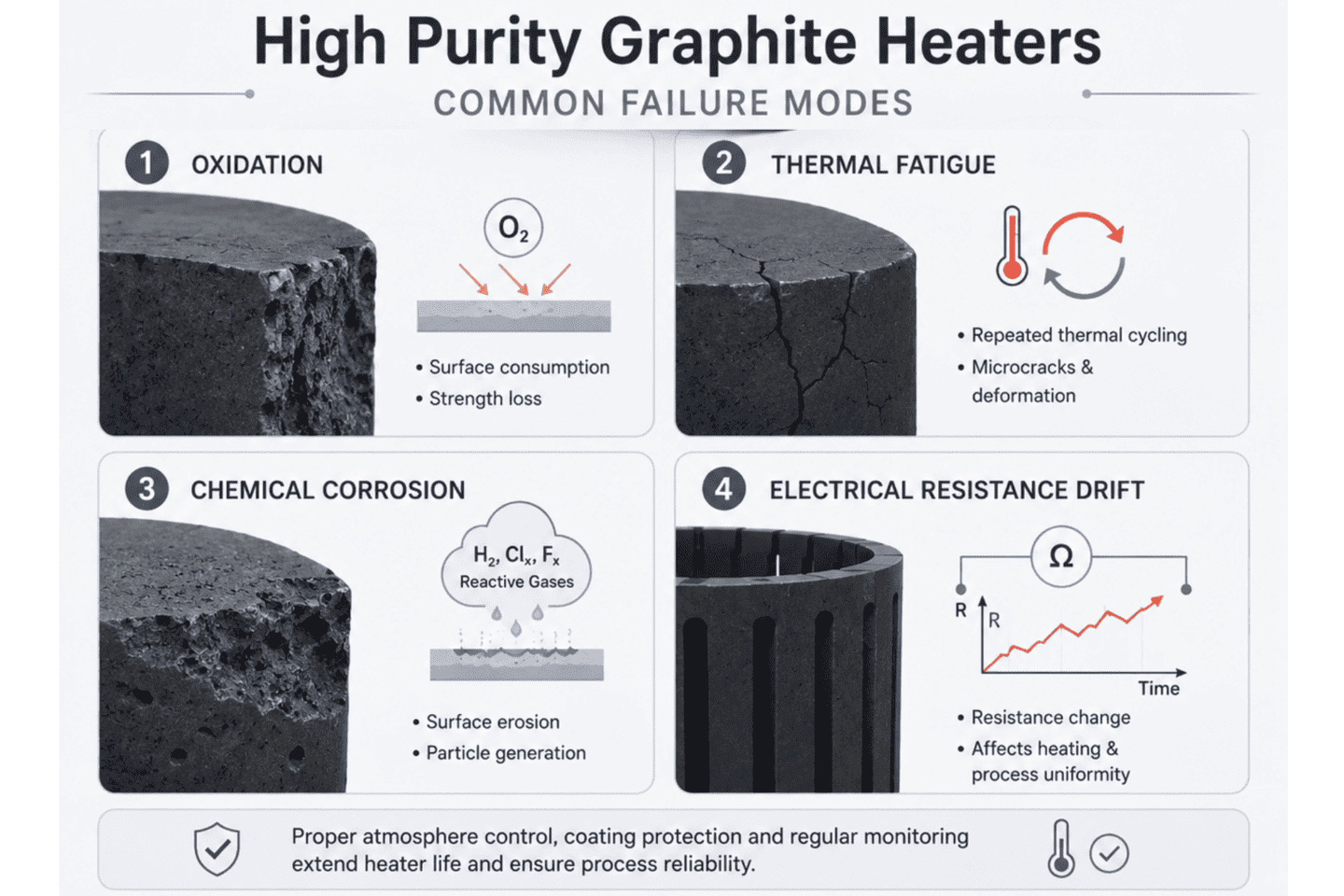
One of the most common causes of degradation is oxidation. Although graphite remains stable in inert or vacuum environments, exposure to oxygen at elevated temperatures gradually consumes the material, reducing mechanical strength and shortening service life. Proper atmospheric control and protective coatings are therefore essential for minimizing oxidation-related damage.
Thermal fatigue is another significant concern. Repeated heating and cooling cycles generate internal stresses that may eventually lead to microcrack formation or localized deformation. As heater geometries become increasingly complex for advanced thermal field optimization, careful structural design becomes increasingly important to minimize stress concentration.
In deposition and epitaxy equipment, chemical corrosion caused by hydrogen, chlorinated silicon precursors, fluorine-containing gases, or other reactive species can gradually erode exposed graphite surfaces. Surface degradation not only affects thermal efficiency but also increases the likelihood of particle generation, introducing contamination risks within the process chamber.
Long-term operation may also result in electrical resistance drift as the graphite microstructure evolves under sustained high temperatures. Variations in electrical resistance alter heating characteristics, potentially affecting temperature uniformity and process repeatability. Routine monitoring of electrical performance has therefore become an important aspect of preventive maintenance in high-volume semiconductor manufacturing.
Future Development
As the semiconductor industry advances toward larger crystal diameters, wider bandgap materials, and increasingly sophisticated thermal processes, graphite heater technology continues to evolve.
Material purification technologies are reducing trace metallic impurities to even lower levels, supporting contamination-sensitive applications such as SiC crystal growth and advanced logic device manufacturing. Meanwhile, improvements in isostatic graphite processing are producing finer and more homogeneous microstructures that offer enhanced mechanical stability and longer operational lifetimes.
Advanced surface engineering has become another major development direction. SiC-coated and TaC-coated graphite heaters are increasingly replacing uncoated graphite in harsh processing environments because they offer superior corrosion resistance, reduced particle generation, and improved process cleanliness. At the same time, digital thermal field simulation using finite element analysis (FEA) and computational fluid dynamics (CFD) is enabling engineers to optimize heater geometry with unprecedented precision, resulting in better temperature uniformity and higher crystal quality.
Why Choose VET Energy
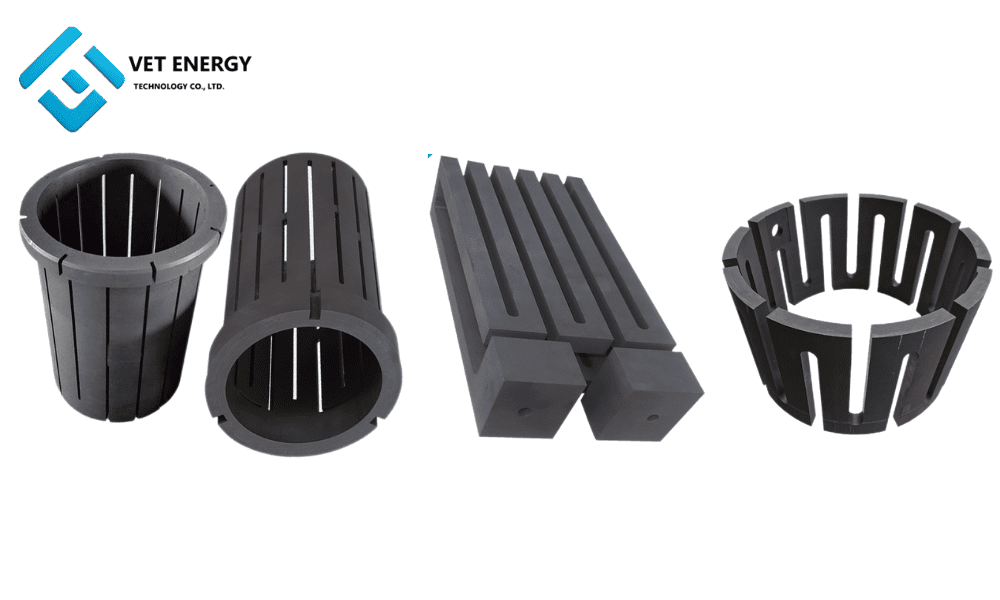
Leveraging its deep expertise in high-temperature materials and advanced precision manufacturing technologies, VET Energy is committed to providing high-purity graphite heaters that meet the growing demands of the semiconductor crystal growth and heat treatment industries. Our engineering team works closely with equipment manufacturers, research institutions, and semiconductor material producers to develop heater solutions that offer exceptional thermal uniformity, structural stability, and long-term operational reliability.
Our graphite heaters are manufactured from high-quality, fine-grained isostatic graphite and undergo rigorous purification and precision machining. They are specifically designed for demanding applications, including SiC PVT crystal growth, Czochralski (CZ) silicon crystal growth, CVD epitaxy, advanced ceramic sintering, and other high-temperature semiconductor processes. For demanding process environments, we also offer SiC-coated and TaC-coated graphite heaters, which provide enhanced oxidation resistance, superior corrosion resistance, reduced particle generation, and a longer service life.
Whether you are developing new crystal growth equipment, upgrading existing thermal field systems, or seeking a trusted supplier of custom graphite components, VET Energy will support your project with professional engineering expertise and responsive technical service.
Contact our team today to discuss your application requirements, request a technical consultation, or obtain solutions tailored specifically to your semiconductor process. By working together, we can create more efficient, reliable, and future-proof thermal systems for advanced semiconductor manufacturing.
Post time: Jul-03-2026