
Introduction: The Critical Role of Furnace Tube Materials in Semiconductor Manufacturing
In semiconductor wafer fabrication, Diffusion Furnace Tube is one of the most critical high-temperature process components used in thermal processing equipment. It provides a controlled reaction environment for several key semiconductor processes, including:
- Thermal oxidation;
- Dopant diffusion;
- Annealing;
- LPCVD deposition;
- High-temperature wafer treatment.
Unlike conventional industrial furnace components, semiconductor furnace tubes must meet extremely strict requirements because even trace contamination or particle generation can directly impact wafer yield and device reliability.
During semiconductor diffusion and oxidation processes, furnace tubes are typically exposed to:
- High temperature environments ranging from 800°C to 1200°C;
- Oxidizing gases such as O₂ and H₂O;
- Inert gases including N₂ and Ar;
- Dopant precursors such as POCl₃ and BBr₃;
- Corrosive chemical species such as HCl.
Therefore, furnace tube materials must simultaneously provide:
- Ultra-high chemical purity;
- Excellent thermal stability;
- Low metallic contamination;
- High corrosion resistance;
- Low particle generation;
- Long operational lifetime.
According to semiconductor equipment material standards and industry practices, the most widely used furnace tube materials include:
- High Purity Quartz (Fused Silica, SiO₂)
- Silicon Carbide (SiC Ceramic)
- Alumina Ceramic (Al₂O₃)
- Silicon Nitride Ceramic (Si₃N₄)
High Purity Quartz Tube
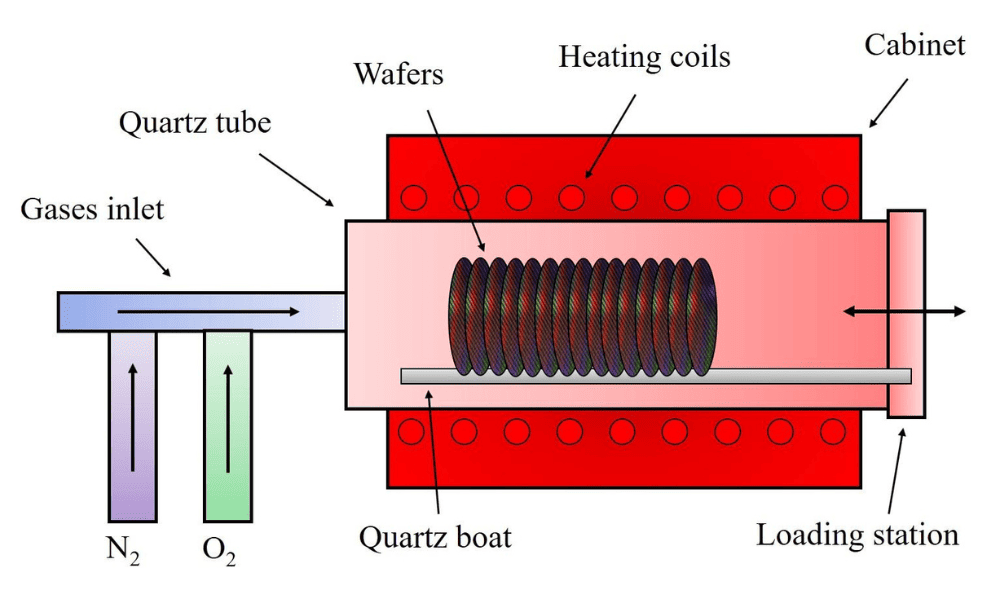
Among all semiconductor furnace tube materials, high purity quartz tube remains the dominant solution for conventional silicon wafer manufacturing due to its outstanding purity, thermal stability and mature processing technology.
Semiconductor-grade quartz tubes are manufactured from high-purity fused silica, where the primary component is silicon dioxide (SiO₂). The purity level typically exceeds 99.99%, with strict control of metallic impurities including: Fe; Na; K; Cu; Al.
In thermal oxidation processes, quartz furnace tubes provide an ideal reaction environment for forming silicon oxide layers.
Typical reactions include:
Dry Oxidation:
Si + O₂ → SiO₂
Wet Oxidation:
Si + H₂O → SiO₂ + H₂
These oxidation processes are essential for:
- Gate dielectric formation;
- Surface passivation;
- Isolation structures.
Quartz tubes are also extensively used in dopant diffusion processes, including:
- Phosphorus diffusion using POCl₃;
- Boron diffusion using BBr₃;
- Arsenic diffusion processes.
In addition, quartz furnace tubes are widely applied in LPCVD systems for:
- Silicon nitride deposition;
- Polycrystalline silicon deposition.
The key advantages of quartz furnace tubes include:
- Excellent Chemical Purity
- Low Thermal Expansion
- Excellent Thermal Uniformity
However, quartz tubes also have certain limitations. The primary limitation is high-temperature mechanical stability. Under prolonged operation above approximately 1100–1200°C, quartz may experience:
- Tube deformation;
- Sagging;
- Reduced mechanical strength.
Therefore, quartz remains the preferred choice for mainstream silicon semiconductor manufacturing but is less suitable for extremely high-temperature or highly corrosive processes.
Silicon Carbide Tube: A High-Temperature Solution for Advanced Semiconductor Manufacturing
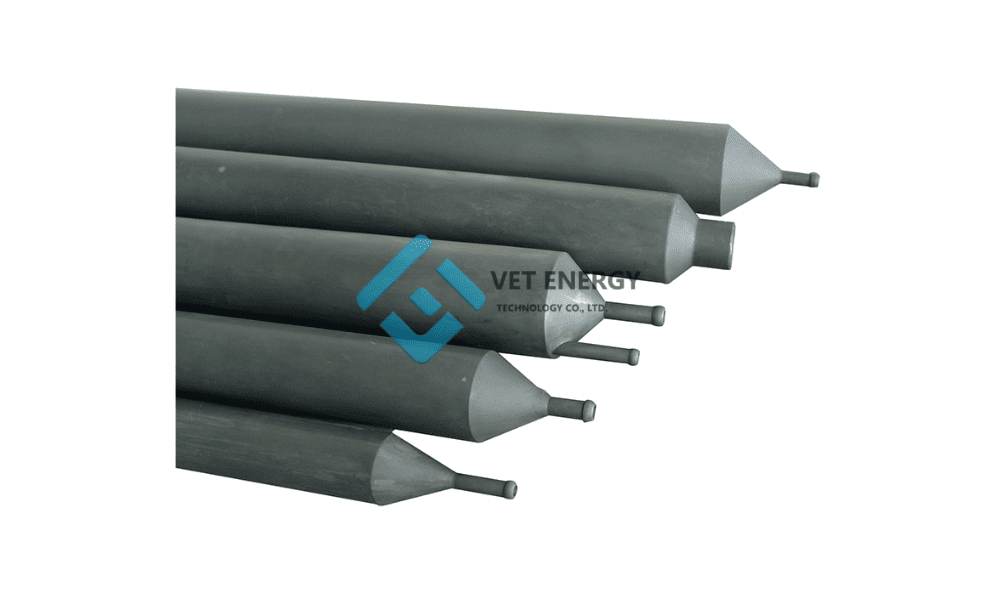
Silicon carbide (SiC) ceramic has emerged as a promising alternative material for advanced furnace tubes.
SiC is a covalent ceramic compound consisting of silicon and carbon atoms. Semiconductor-grade SiC ceramics typically include:
- Reaction bonded SiC;
- Sintered SiC;
- High purity CVD SiC materials.
Compared with quartz, SiC provides significantly improved:
- Temperature resistance;
- Mechanical strength;
- Thermal conductivity;
- Chemical durability.
One of the most significant advantages of SiC furnace tubes is their superior high-temperature capability.
While quartz is generally limited to approximately 1200°C operating conditions, SiC ceramics can withstand temperatures exceeding 1500°C, making them suitable for advanced thermal processes.
The thermal conductivity difference is also significant:
- Quartz: ~1.4 W/m·K
- Silicon Carbide: 120–200 W/m·K
The higher thermal conductivity of SiC enables:
- Faster thermal response;
- Improved temperature uniformity;
- Reduced thermal gradients.
In semiconductor applications, SiC furnace tubes are mainly considered for:
- High-temperature annealing;
- Advanced diffusion processes;
- Silicon carbide power device manufacturing;
- GaN semiconductor processing.
Alumina Tube (Al₂O₃): A Cost-Effective High Temperature Ceramic Material
Alumina ceramic tubes are manufactured primarily from aluminum oxide (Al₂O₃), typically with purity levels ranging from 95% to 99.8%.
The operating temperature capability of alumina ceramics can reach approximately: 1400–1700°C. which is higher than conventional quartz.
Because of these characteristics, alumina furnace tubes are commonly used in:
Laboratory semiconductor furnaces;
- l Research and development equipment;
- l Experimental thermal processing systems.
However, alumina has limited adoption in high-volume semiconductor manufacturing. The main reason is contamination control.
Compared with quartz, alumina ceramics may introduce:
- Aluminum contamination;
- l Higher impurity levels.
For advanced semiconductor production requiring extremely low contamination levels, quartz and high-purity SiC remain preferred choices.
Silicon Nitride Tube (Si₃N₄): Advanced Ceramic for Thermal Shock Resistance
Silicon nitride (Si₃N₄) is another advanced ceramic material known for its exceptional mechanical properties. Potential semiconductor applications include:
- Specialized furnace components;
- Research semiconductor equipment;
- High-temperature ceramic structures.
However, Si₃N₄ furnace tubes are not widely adopted in mainstream semiconductor diffusion furnaces due to:
- Higher manufacturing complexity;
- Higher cost;
- Limited industrial supply chain maturity.
Conclusion
The Diffusion Furnace Tube is a critical but often underestimated component in semiconductor manufacturing. Its material directly influences:
- Wafer yield;
- Process stability;
- Particle performance;
- Equipment lifetime.
Currently:
Quartz tubes dominate conventional oxidation and diffusion processes due to their exceptional purity and maturity.
SiC tubes provide advanced thermal capability for next-generation semiconductor applications.
Alumina and silicon nitride tubes serve specialized high-temperature applications where mechanical performance is prioritized.
As semiconductor manufacturing continues toward higher temperatures, larger wafers and wide-bandgap devices, advanced ceramic furnace tube materials will play an increasingly important role in future semiconductor process equipment.
Post time: Jul-24-2026