
In the ever-evolving electrochemical energy systems, graphite felt stands out as a versatile carbon-based material, possessing unique structural, electrical, and chemical properties. While not all fuel cell architectures universally employ graphite felt, its role—especially in advanced fuel cell and hybrid fuel cell systems—has increasingly attracted the attention of engineers and system designers dedicated to optimizing fuel cell performance at both the materials and process levels.
I. Basic characteristics of Graphite felt
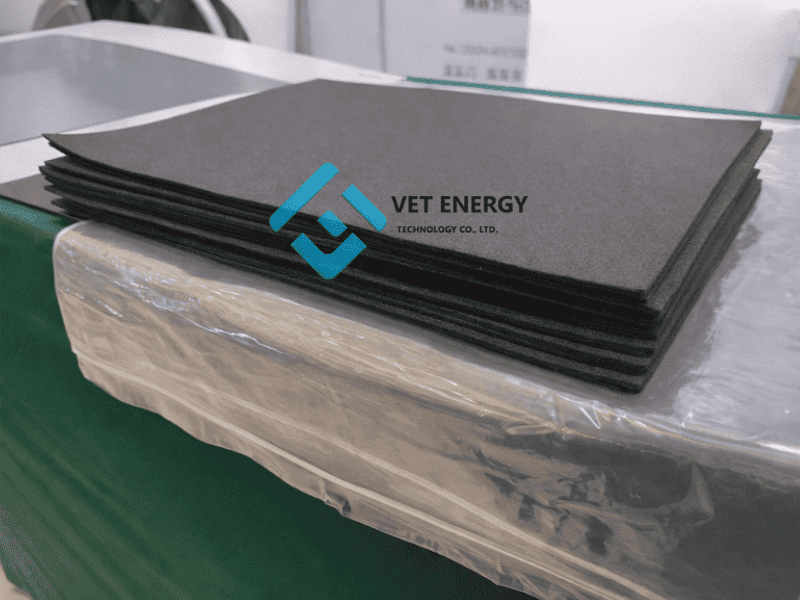
From a materials science perspective, graphite felt is a three-dimensional porous network composed of interwoven carbon fibers, typically derived from polyacrylonitrile (PAN) or pitch precursors and graphitized at high temperatures. This structure endows graphite felt with a range of properties particularly important in electrochemical environments:
● High electrical conductivity: ensuring electron transport
● High porosity (>90%): facilitating gas or liquid permeation
● Strong corrosion resistance: adaptable to acidic/oxidizing environments (e.g., PEMFCs)
● Good compression resilience: contributing to contact stability
● High temperature resistance: suitable for high-temperature electrochemical systems
II. The Role of Graphite Felt in Different Fuel Cells
The application of graphite felt in fuel cell technology varies significantly depending on the system architecture.
1. In Flow Batteries (e.g., vanadium redox flow batteries) – Core Electrode Material
In liquid-phase electrochemical systems – especially flow batteries, which are often discussed alongside fuel cell technology due to their similar electrochemical principles – graphite felt is used as the primary electrode material. Its high specific surface area and interconnected porous structure provide abundant active sites for redox reactions while promoting electrolyte flow. Surface modification processes such as thermal activation or oxidation are typically employed to enhance its wettability and catalytic activity, directly impacting system efficiency and cycle stability.
2. In PEM Fuel Cells (Proton Exchange Membrane Fuel Cells) – Auxiliary Diffusion/Support Material
In contrast, in proton exchange membrane (PEM) systems, graphite felt is not a conventional choice for the gas diffusion layer (GDL). Carbon paper or carbon cloth dominates due to its optimized balance in conductivity, mechanical stiffness, and manufacturability. However, graphite felt has found unique applications in some specialized PEM configurations, particularly where enhanced water management or gas distribution is required. Its high porosity can improve mass transfer performance under high humidity or moisture-prone conditions, but this introduces trade-offs in contact resistance and compressive stability, which must be addressed through carefully designed stack and pressure control.
3. In High-Temperature Fuel Cells (SOFCs, etc.) – Auxiliary Conductive/Sealing Buffer
In high-temperature systems (e.g., solid oxide electrolyzers), graphite felt is typically not used as a primary electrochemical component due to the dominance of ceramic materials in the electrodes and electrolyte. However, it can serve auxiliary functions, including conductive buffering, sealing support, or accommodating thermal expansion in auxiliary equipment or interfacial regions. While these roles are secondary, they are crucial for ensuring long-term durability and mechanical integrity under extreme operating conditions.
III. Summary of Key Roles in Fuel Cell Technology
From a process engineering perspective, the value of graphite felt lies in its ability to integrate multiple functions within a single material. Its three-dimensional structure allows for the formation of extended electrochemical interfaces, effectively increasing the active reaction area without significantly increasing the system footprint. Simultaneously, it contributes to uniform fluid distribution, mitigating concentration gradients and reducing polarization losses associated with mass transfer limitations. Proper integration of graphite felt facilitates the formation of a continuous conductive network, thereby reducing internal resistance and improving overall system efficiency.
Furthermore, it plays a crucial role in mechanical and assembly optimization. The inherent compressibility and resilience of graphite felt allow it to adapt to manufacturing tolerances and maintain stable interfacial contact under stacking conditions. This characteristic is particularly advantageous in modular or large-scale systems, as uniform distribution is essential for performance consistency.
IV. Why Choose VET Energy?
In the field of fuel cells and related high-temperature electrochemical applications, VET Energy, leveraging its continuous R&D investment and engineering experience in carbon-based materials, has built a comprehensive product system of graphite felt and composite materials covering various application scenarios, providing highly tailored solutions for different types of fuel cells. VET Energy’s material solutions have been widely applied across various technologies, including proton exchange membrane fuel cells and solid oxide fuel cells, and have been scaled up and validated in extended systems such as flow batteries. If you are exploring the application potential of graphite felt and related carbon materials in electrochemical systems, or wish to further optimize existing processes and performance, please feel free to contact us for discussion and collaboration to jointly promote the development of next-generation fuel cell technology.
Post time: Apr-03-2026