
As semiconductor manufacturing evolves toward smaller device geometries, higher wafer throughput, and increasingly stringent contamination control standards, thermal processing equipment is facing unprecedented engineering challenges. Processes such as LPCVD, thermal oxidation, dopant diffusion, and high-temperature annealing now demand not only tighter temperature uniformity, but also longer equipment uptime, lower particle generation, and improved process repeatability.
Although often overlooked compared with process gases, furnace tubes, or deposition chemistries, the cantilever paddle fundamentally determines how wafers behave inside high-temperature environments. In many advanced fabs, it is no longer considered a simple consumable component, but rather a key enabling material for stable and repeatable semiconductor processing.
What Is a SiC Cantilever Paddle?
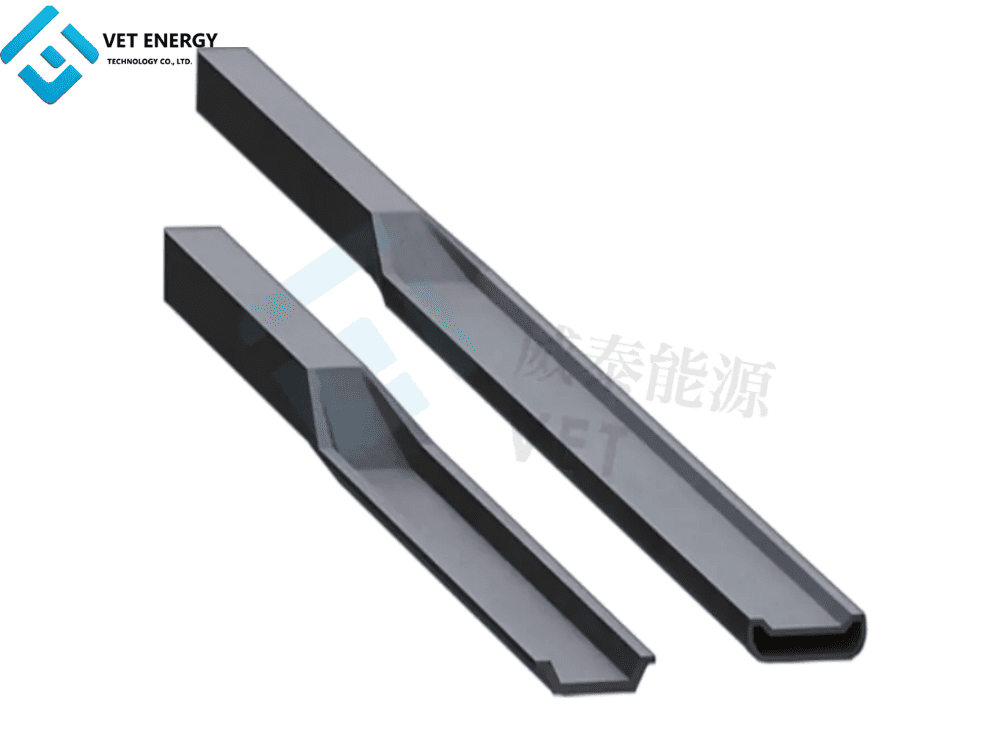
A SiC Cantilever Paddle is a high-purity silicon carbide structural component used primarily in semiconductor diffusion furnaces and LPCVD systems. It is typically designed as a long cantilever beam structure capable of supporting quartz or SiC wafer boats during high-temperature processing.
The component is generally manufactured using:
● recrystallized silicon carbide (RSiC)
● chemical vapor deposited silicon carbide (CVD SiC)
● high-density reaction-bonded SiC materials
According to material data published by CoorsTek and Saint-Gobain Performance Ceramics, high-purity SiC materials typically exhibit:
● Thermal conductivity: approximately 120–200 W/m·K at room temperature
● Maximum operating temperature in inert atmosphere: above 1600°C.
● Coefficient of thermal expansion (CTE): approximately 4.0–4.5×10⁻⁶/K.
● Excellent resistance to HCl, NH₃, O₂, and chlorinated process chemistry.
The Role of SiC Cantilever Paddle in LPCVD Processing
Among all applications, LPCVD systems represent one of the most important use cases for SiC Cantilever Paddles.
Processes such as:
● polysilicon deposition.
● silicon nitride (Si₃N₄).
● low-pressure oxide deposition.
Typically operate between 500°C and 900°C, often under long process cycles and highly reactive chemical environments.
Inside these systems, the cantilever paddle performs several essential functions simultaneously.
First, it provides stable mechanical transport for wafer boats entering and exiting the furnace tube. Because modern vertical furnaces may carry hundreds of wafers per batch, even slight paddle deformation can lead to wafer misalignment, unstable spacing, or mechanical stress accumulation.
Second, the paddle plays an important role in thermal uniformity. SiC’s high thermal conductivity allows heat to distribute more evenly along the support structure, minimizing localized thermal gradients that may affect deposition uniformity.
Third, low particle generation is critical. Semiconductor particles are direct yield killers, especially in advanced logic and power semiconductor production. Due to its dense ceramic structure and strong corrosion resistance, high-purity SiC significantly reduces the risk of particle shedding compared with traditional materials.
In advanced LPCVD production lines, the long-term dimensional stability of the paddle directly impacts:
● film thickness consistency.
● wafer-to-wafer repeatability.
● furnace uptime.
Ningbo VET Energy specializes in advanced graphite, silicon carbide ceramics, and CVD-coated semiconductor components designed for demanding semiconductor manufacturing environments.
The Core semiconductor products include:
● SiC Cantilever Paddle
● SiC Coated Graphite Susceptor
● SiC Coated Wafer Carrier
● SiC Coated Halfmoon Components
● Carbon-Carbon Composite Crucibles
● Soft Graphite Felt & Rigid Graphite Felt
These products are widely used in:
● Epitaxy systems
● LPCVD reactors
● Diffusion furnaces
● SiC crystal growth systems
● High-temperature thermal processing equipment.
With the rapid growth of SiC and advanced power semiconductor manufacturing, the demand for high-purity, high-stability furnace components will continue to increase. In this context, SiC Cantilever Paddle technology will remain one of the foundational elements supporting next-generation semiconductor processing.
Post time: May-14-2026