
I. The Central Role of Graphite Bipolar Plates in the Industry Boom
Against the backdrop of the “dual carbon” goals and the rapid development of the hydrogen economy, fuel cells (especially PEM fuel cells) are transitioning from the demonstration phase to large-scale application. From passenger vehicles to distributed power generation systems, the system efficiency, lifespan, and cost of fuel cells are becoming key indicators of industry competition.
In this system, the graphite bipolar plate is not merely an “auxiliary component,” but one of the core functional elements that determine the performance of the fuel cell stack. Research indicates that bipolar plates account for approximately 60–80% of the weight and 40–50% of the cost of a fuel cell stack; their design and material selection directly impact system power density, durability, and manufacturing costs.
From a working mechanism perspective, graphite bipolar plates achieve the stable and continuous electrochemical reaction of fuel cells by highly integrating multiple functions—including “current conduction, gas distribution, thermal management, and structural support”—making them the true “multi-physics coupling core component” within the stack.
II. The Role and Operating Principles of Graphite Bipolar Plates in Fuel Cells
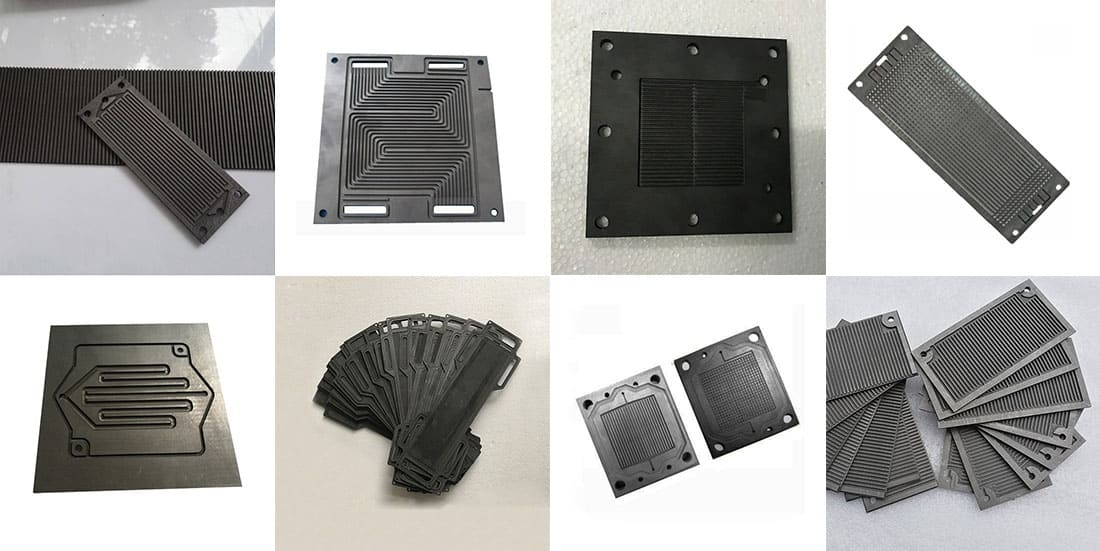
In a typical proton exchange membrane fuel cell (PEMFC), graphite bipolar plates are located on both sides of the membrane electrode assembly (MEA), integrating the functions of series-connected fuel cell units through their double-sided structure.
Its operating principle can be understood through the following four coupled processes:
First is the current collection and conduction mechanism. During the fuel cell reaction, hydrogen loses electrons at the anode, and these electrons are output as power through the external circuit. The bipolar plate is responsible for guiding electrons from one cell to the next. The intrinsic electrical conductivity of graphite can reach the order of 10⁴ S/cm, significantly reducing ohmic losses and thereby improving system efficiency.
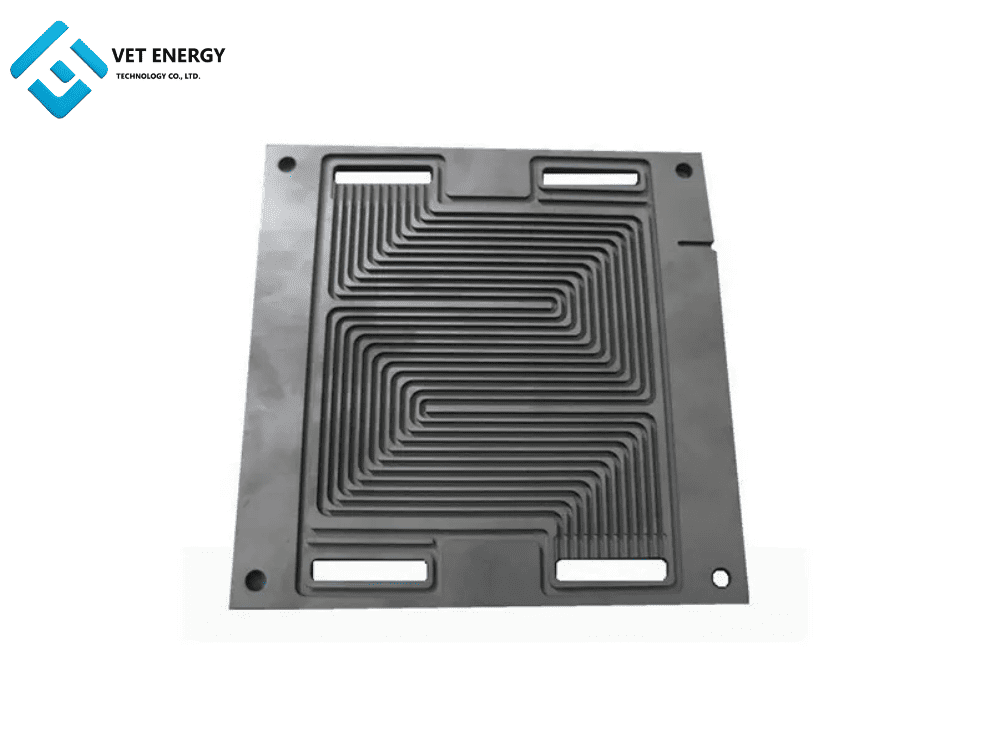
Second is the mechanism of reactant transport and flow field control. The bipolar plate surface is machined with precision flow channels to uniformly distribute hydrogen and air and to remove water generated by the reaction. This process is essentially a gas-liquid two-phase flow control problem, and its design directly affects mass transfer efficiency and battery performance stability.
Third is the thermal management mechanism. Fuel cells generate heat during operation; if this heat cannot be effectively dissipated, it will lead to localized hot spots and accelerate membrane electrode aging. Graphite’s excellent thermal conductivity allows it to rapidly and uniformly disperse heat within the plane, thereby maintaining a stable temperature field within the stack.
Finally, there is the sealing and isolation mechanism. Through structural design and a coordinated sealing system, the bipolar plate ensures strict separation of hydrogen and oxygen, preventing gas cross-contamination. This not only affects efficiency but also directly impacts system safety.
In summary, the operating principle of graphite bipolar plates is not a single physical process, but rather the result of the synergistic interaction of a multi-field coupled system involving electrical, thermal, flow, and structural factors.
III. Why Choose Graphite: An Analysis of Key Physical Properties
Graphite has become a widely used bipolar plate material, both historically and today, due to its comprehensive advantages across multiple key performance metrics.
In terms of electrical properties, graphite exhibits excellent electrical conductivity; its layered structure provides a continuous path for electron transport, making it an ideal material for meeting DOE technical specifications (conductivity > 100 S/cm).
In terms of chemical stability, graphite exhibits exceptional corrosion resistance. In the acidic and high-potential environment of fuel cells, metallic materials often corrode and form passivation layers, thereby increasing contact resistance. In contrast, graphite possesses inherent chemical inertness, enabling long-term stable operation.
Regarding thermal properties, graphite has high thermal conductivity, which helps achieve uniform temperature distribution within the stack and prevents damage to the membrane electrode caused by localized overheating.
Furthermore, graphite offers excellent gas barrier properties (which can be further enhanced through impregnation), effectively preventing hydrogen and oxygen permeation and ensuring system integrity.
However, from an engineering perspective, graphite has significant limitations. For instance, it is highly brittle, difficult to process, and typically requires a thickness of several millimeters (>2–5 mm), which hinders efforts to achieve lightweight and high-power-density stack designs. Consequently, composite graphite and metal alternatives have gradually become a research focus in recent years.
IV. Industry Trends and Future Outlook
As the commercialization of fuel cells accelerates, bipolar plate technology is undergoing rapid evolution, with its development clearly driven by both materials and manufacturing advancements.
On one hand, in passenger vehicles and high-power-density applications, the industry is gradually transitioning from traditional graphite bipolar plates to metal bipolar plates (such as stainless steel and titanium alloys). These materials can achieve sub-millimeter thicknesses, and stamping processes significantly reduce manufacturing costs, thereby meeting the demands of mass production.
On the other hand, graphite composite bipolar plates are emerging as a key transitional solution. By incorporating conductive fillers such as resins and carbon nanotubes, these materials can maintain high electrical conductivity and corrosion resistance while improving mechanical strength and reducing processing costs.
At the same time, advanced manufacturing technologies (such as additive manufacturing) are driving the design of bipolar plate flow channels toward greater complexity and efficiency, thereby enhancing the overall performance and energy utilization efficiency of fuel cells.
In the long term, graphite bipolar plates will remain competitive in the following areas:
● Stationary power generation systems (where cost and lifespan are critical factors)
● Low-to-medium power applications
● Alkaline or specific operating condition electrochemical systems
As a leading Chinese manufacturer and supplier of graphite bipolar plates, Ningbo VET Energy has developed advanced graphite bipolar plates for PEMFCs that are cost-effective, highly conductive, and mechanically robust. VET Energy also offers resin-impregnated graphite materials to achieve gas impermeability and high strength, while retaining graphite’s inherent superior electrical and thermal conductivity.
More importantly, VET Energy supports customized graphite bipolar plate design requirements. We can machine both sides of the plates to create flow channels, machine only one side, or provide unmachined blank plates. All graphite plates can be processed according to your detailed specifications. We look forward to your further inquiries.
Post time: Apr-10-2026