
In modern semiconductor device fabrication and third-generation compound semiconductor production (such as Silicon Carbide [SiC] and Gallium Nitride [GaN]), industry discussions often center around ultra-advanced EUV lithography machines, plasma etchers, or precursor gas purity. However, inside the ultra-clean, highly corrosive, and high-temperature environment ofthe reaction chamber sits a critical unsung hero: the Graphite susceptor.
1. What is a Graphite Susceptor?
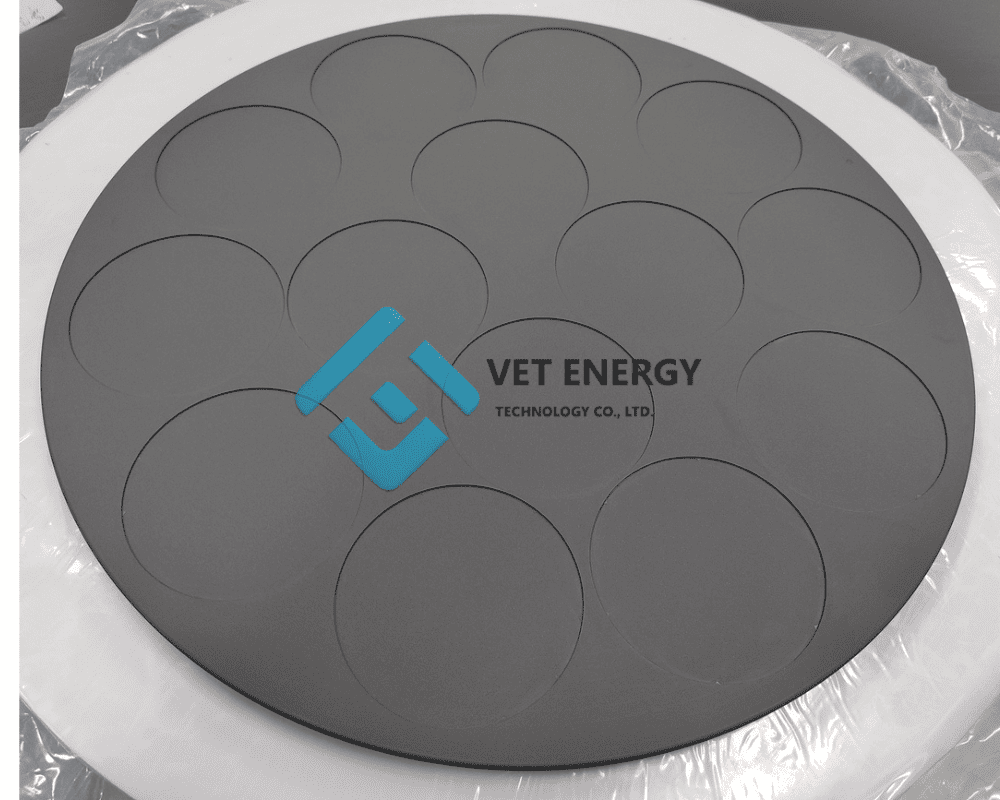
A Graphite susceptor is a precision-engineered functional carrier component crafted from high-purity iso-molded or extruded graphite, often featuring disk-shaped, pocketed, or custom three-dimensional geometries tailored to fit specific reaction chambers.
In equipment such as Chemical Vapor Deposition (CVD), Metal-Organic Chemical Vapor Deposition (MOCVD), and Rapid Thermal Processing (RTP) reactors, the primary function of the carrier platform is to securely hold semiconductor wafers while serving as the primary heat exchanger. Utilizing Graphite susceptor induction heating mechanisms, the component rapidly absorbs Radio Frequency (RF) or microwave electromagnetic energy and converts it into uniform thermal energy, facilitating millisecond-level precision thermal control across the wafer surface.
2. Material Composition & Micro structure: Why Isostatic Graphite + CVD SiC Coating?
Uncoated raw graphite cannot survive the aggressive chemical atmospheres and stringent cleanliness requirements of semiconductor fabrication. Modern high-performance Graphite susceptors utilize a specialized dual-layer composite system:
(1) High-Purity Isostatic Graphite Substrate
The core substrate is manufactured using isostatically pressed graphite. By optimizing the graphite micro crystalline alignment, it achieves isotropic physical properties, low porosity, and high mechanical flexural strength, providing an ideal foundation for micro-machining intricate wafer pocket geometries.
(2) CVD Silicon Carbide (SiC) Protective Coating
Using Chemical Vapor Deposition, a highly dense layer of poly-crystalline B-SiC (typically 10 to 100 um thick with 99.999% purity) is grown over the graphite substrate. This coating completely seals graphite surface micro-pores, prevents particulate shedding, and provides an impermeable barrier against corrosive etching gases like HCI, NH,, and fluorinated compounds.
3. Key Physical Properties & Material Specifications
Based on rigorous laboratory testing and validated industry benchmarks, high-purity coated Graphite susceptors exhibit the following critical physical parameters:
|
Physical / Chemical Parameter |
Standard Reference Value |
Process Advantage & Performance Impact |
|
Total Ash Content (Purity) |
< 5 ppm (Ref: XR Graphite Spec Data) |
Eliminates metallic contamination, ensuring defect-free epitaxial layers. |
|
Apparent Density |
Substrate: 1.85 g/cm³ | SiC: 3.21 g/cm³ |
Low thermal inertia for fast ramp rates coupled with an impermeable shell. |
|
Flexural Strength |
≥ 49 MPa (Substrate) | ~450 MPa (SiC) |
Withstands extreme thermal stress and heavy wafer loading without warping. |
|
Max Operating Temperature |
> 1500°C – 1800°C |
Maintains structural integrity during high-temperature SiC crystal growth. |
|
Thermal Conductivity |
~116 W/m·K (100 kcal/cm·h·°C) |
Rapidly disperses localized hot spots, achieving minimal thermal gradient (ΔT). |
|
Electrical Resistivity |
~11 μΩ·m |
Optimized for highly efficient Graphite susceptor induction heating. |
Core Engineering Advantages:
1. Superior Thermal Shock Resistance: Capable of enduring continuous rapid heating and cooling cycles (above 1500°C) without cracking or delamination.
2. Chemical Inertness: Completely immune to degradation from H2, NH3, silane gases, and harsh chemical cleaning agents.
3. Coefficient of Thermal Expansion (CTE) Matching: VET Energy’s proprietary SiC deposition process aligns the thermal expansion behavior of the SiC coating with the graphite core, preventing coating fracture at extreme temperatures.
4. Role & Applications in Semiconductor Processing
High-reliability Graphite susceptors serve as foundational enabling components across several critical semiconductor manufacturing steps:
(1) CVD and MOCVD Epitaxial Growth (Epi)
In GaN LED fabrication, SiC power device epitaxy, and silicon wafer epi-growth, film thickness and doping uniformity depend heavily on thermal field homogeneity. Graphite susceptors distribute heat evenly across single or multi-wafer configurations during rotation, suppressing thermal stress-induced wafer bowing or slip lines.
(2) Single Crystal Growth (PVT Method)
During Silicon Carbide (SiC) and Sapphire crystal growth via Physical Vapor Transport (PVT), the susceptor defines the thermal zone gradient, directly guiding single-crystal ingot formation and reducing dislocation density.
(3) Rapid Thermal Processing (RTP) & Annealing
Leveraging efficient Graphite susceptor induction heating, the platform enables ultra-fast thermal response times needed for post-implantation lattice annealing and junction formation.
5. Why Choose VET Energy?
With demanding requirements for supply chain resilience, extreme purity, and extended service life, VET Energy stands out as a trusted global engineering partner:
1. Precision Micro-Machining: Multi-axis CNC machining centers enable intricate wafer pockets, micro-grooves, and custom aerodynamic gas channels with tolerances down to the micrometer level.
2. Advanced Dense CVD SiC Deposition: Our proprietary CVD process achieves highly dense, mirror-polishable SiC coatings that extend thermal cycle operational lifespan by over 30%.
3. Ultra-Clean Processing Environment: Full purification and cleanroom handling guarantee total ash content consistently kept below 5 ppm, satisfying stringent OEM semiconductor Fab standards.
4.Optimized Cost of Ownership (CoO): VET Energy delivers accelerated lead times along side competitive price-to-performance ratios, helping chip makers reduce consumable expenditure.
Post time: Aug-14-2026