
In the aluminum smelting and molten aluminum degassing industry, graphite rotors have almost become standard equipment. Many factories are well aware that without an anti-oxidation coating, the rotor will quickly be consumed. Consequently, various “high-temperature anti-oxidation coatings” have flooded the market. However, when it comes to actual production sites, a common question arises: why does the coating, which is supposed to protect the graphite rotor, often become the first component to fail under high-temperature, long-term, and severe conditions? Professionals with years of experience in the semiconductor industry frequently encounter such issues. Therefore, to select and use graphite rotor anti-oxidation coatings effectively, it is essential to first understand the failure mechanisms of the coatings and then examine how a company truly proficient in material surface treatment can differentiate itself in key areas.
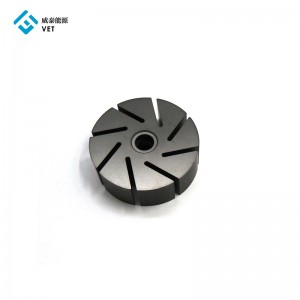
I. Why can’t graphite rotors do without an anti-oxidation coating?
Graphite itself is very “friendly” to molten aluminum:
- Low density and light weight, reducing transmission load;
- Good thermal shock resistance, not prone to cracking under repeated thermal cycling;
- Easy to process, allowing for complex rotor impeller structures that facilitate aluminum liquid stirring and bubble dispersion.
However, it also has a fatal weakness: it will be continuously oxidized and consumed in high-temperature oxygen-rich environments.
In typical aluminum smelting conditions:
- The temperature of molten aluminum often ranges from 720–780°C, with some conditions being even higher;
- Part of the rotor is exposed to furnace atmosphere, where oxygen and combustion products are unavoidable;
- The rotor rotates at high speed, constantly exposing fresh high-temperature graphite to the atmosphere.
Without an effective anti-oxidation coating, the rotor will exhibit:
- Surface layers being gradually “burned away”, with noticeable size reduction in weeks or even days;
- Surface becoming rough and porous, leading to uneven bubble dispersion and reduced degassing efficiency;
- Oxidized powder and debris falling off, becoming inclusion sources in the molten aluminum.
The mission of the anti-oxidation coating is to help graphite withstand this “chronic consumption battle” under high-temperature, oxygen-rich, and molten aluminum and slag environments.
II. Why Do Coatings Tend to Fail First Under Extreme Conditions?
In routine failure analysis, the most frequently encountered situations can be grouped into several typical scenarios:
1. Thermal Expansion Mismatch: A Good Coating “Tears Itself Apart”
- The thermal expansion behavior of graphite and inorganic coating materials is very different:
- Graphite is highly anisotropic, with different expansion in different directions;
- Many ceramic or glassy coatings have higher thermal expansion coefficients and are much more “rigid.”
During repeated cycles of heating, soaking, shutdown, and cooling, the two materials do not expand and contract synchronously:
- Microcracks start to appear in the coating;
- These cracks continue to propagate under rotor rotation and molten aluminum scouring;
- Eventually, large areas of the coating spall off, exposing the graphite substrate locally.
On the surface it looks like “poor coating quality,” but in fact, thermal matching with graphite was never treated as a strict design constraint at the formulation and structural design stage.
2. Pores and Pinholes: High-Speed Channels for Oxygen and Molten Aluminum
In some coatings, the microstructure is not truly dense:
- Improper particle size distribution leaves interconnected pores after sintering;
- Non-uniform application and drying lead to pinholes and trapped bubbles;
- Poor control of the firing curve results in locally under-sintered regions.
These invisible defects are greatly amplified under extreme service conditions:
- Oxygen penetrates through the pores and begins to oxidize the graphite from beneath the coating;
- The layer under the coating is gradually hollowed out, forming “blisters” or voids;
- One day, in the middle of production, an entire patch of coating suddenly detaches.
What is typically observed on site is that both the back side of the fallen coating and the exposed graphite surface are already loose and powdery.
3. Ignoring the Chemical Corrosion from Molten Aluminum and Slag
Truly extreme service conditions are not just about high temperature. They also include:
- Complex aluminum alloy systems with high Mg, high Si, or rare earth additions;
- Residues of chloride- and fluoride-based refining and covering agents;
- Slag adhering to the rotor surface over long periods of time.
If a coating formulation only focuses on being “high-temperature resistant” while neglecting these chemical factors, the following problems are likely to occur:
- Certain coating components locally react with molten aluminum or slag, forming low-melting-point phases;
- Under long-term contact, the coating gradually softens and is chemically eroded, with the surface being “eaten away” bit by bit;
- The coating surface becomes rough, the flow field deteriorates, and degassing efficiency drops.
Short-term high-temperature tests in the laboratory can hardly reproduce the cumulative effects of this kind of long-term chemical attack.
4. Process Instability: A Good Formulation “Used the Wrong Way”
Another common situation is:
- The same formulation shows very different service lives across different batches or different plants;
- A new batch is put into service and the coating starts peeling almost immediately, which is hard for the production site to accept.
Tracing back to the root cause, the problems are often found in process details:
- Inadequate substrate surface preparation, with dust and oil contamination compromising adhesion;
- Non-uniform coating thickness, causing weak spots to fail first;
- Poor control of firing temperature and holding time, leading to an unstable coating microstructure.
For coating products, the formulation is the foundation, but stable and well-controlled processing is the real guarantee of service life.
III. How Does a Company That Truly Understands Surface Engineering Work?
In our company, the long-term focus has been on materials surface engineering and functional coatings for high-temperature components. For the extreme working conditions of graphite rotors in the aluminum refining industry, we address the problem from four key dimensions.
1. Designing the Coating Formulation Starting From the Graphite, Not Forcing a Coating Onto Any Substrate
We always begin with a detailed materials analysis of the customer’s graphite substrate:
- Understand its pore structure, density grade, and anisotropic thermal expansion behavior;
- Evaluate the actual operating temperature profile and the frequency of thermal cycling;
- Combine this with rotor geometry to identify high-stress and high-wear regions.
On this basis, we carry out targeted coating formulation design:
- Control the overall thermal expansion coefficient of the coating so that it is as close to graphite as possible;
- Use a multi-phase composite system to balance stiffness and toughness;
- Adjust coating thickness and layer structure in high-stress regions to reduce the risk of cracking.
What we provide is not “one coating for everyone,” but a complete solution built around the graphite substrate.
2. Controlling the Microstructure: Making the Coating Truly “Dense,” Not Just “Intact to the Eye”
To tackle pores and pinholes, we work simultaneously from both raw materials and process sides:
- Optimize particle size distribution and solid content so that the coating forms a continuous, dense structure after sintering;
- Control drying and firing curves within a defined process window to minimize internal stress and microcracks;
- Perform cross-section metallography, porosity measurements, and adhesion tests on key batches, letting data speak for itself.
Under extreme service conditions, this translates into:
- Even when local wear occurs, the coating tends to thin gradually rather than spalling off in large flakes;
- The variation range of service life is significantly narrowed, making process planning and maintenance scheduling easier.
3. Designing Corrosion Resistance for Specific Molten Aluminum and Slag Systems
We perform customized corrosion-resistance evaluations based on each user’s aluminum alloy and auxiliary material systems:
- Carry out immersion tests for high-magnesium and high-silicon aluminum alloys separately;
- Simulate environments with common refining and covering agent residues to test the chemical stability of the coating;
- Adjust formulation components to reduce the risk of low-melting or brittle phases forming between the coating and molten aluminum.
From the user’s perspective, the benefits are very tangible:
- Local “melted-out” pits on the rotor surface no longer occur;
- Slag is less likely to sinter tightly onto the coating surface, reducing cleaning difficulty;
- Molten aluminum cleanliness becomes more stable, and gas porosity and inclusion defects in downstream castings are reduced.
4. Bringing Process Stability Into Quality Control, Not Just Leaving It on a Data Sheet
In production, we treat surface pretreatment, coating application, and firing as a single integrated process chain:
- Standardized substrate cleaning and roughening procedures to ensure a reliable “anchor” for the coating;
- Selecting the appropriate application method (dipping, spraying, or brushing) according to rotor geometry, with in-line thickness control;
- Recording and tracing furnace temperature, atmosphere, heating and cooling rates to ensure batch-to-batch consistency.
At the same time, we pursue continuous improvement based on field feedback:
- Regularly perform cross-section analysis on returned, failed rotors to identify the real failure location and mechanism;
- Feed these analysis results back into formulation and process optimization, rather than simply “making it thicker” or “making it harder.
Post time: Nov-19-2025