
After the ceramic substrate is sintered and formed, its surface needs to be metallized, and then the surface pattern is made through image transfer to achieve the electrical connection performance of the ceramic substrate. Surface metallization is a crucial step in the fabrication of ceramic substrates. This is because the wetting ability of metals to ceramic surfaces at high temperatures determines the bonding force between metals and ceramics. Good bonding force is an important guarantee for the stability of LED packaging performance.At present, the common metallization methods on ceramic surfaces can be roughly classified into several forms, including co-burning methods (HTCC and LTCC), thick film method (TFC), direct copper deposition method (DBC), direct aluminum deposition method (DBA), and thin film method (DPC)
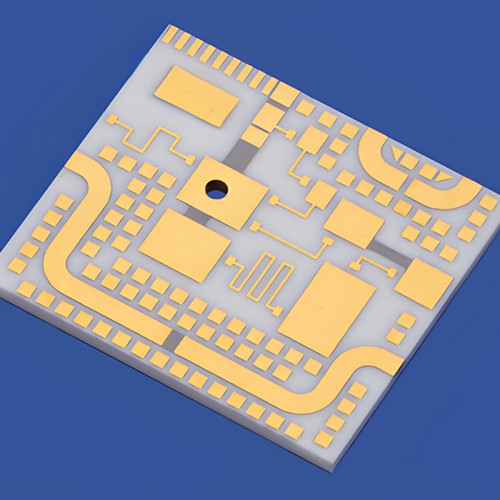
Co-firing Method (HTCC/LTCC)
There are two types of co-firing methods: one is high-temperature co-firing (HTCC), and the other is low-temperature co-firing (LTCC). The process flows of both are basically the same. The main production process flows include slurry preparation, casting and generating strips, drying green bodies, drilling through holes, screen printing and filling holes, screen printing circuits, layering and sintering, and the final slicing and other post-treatment processes. Alumina powder is mixed with organic binders to form a slurry, and then the slurry is processed into sheets with a scraper. After drying, a ceramic green body is formed [10]. Then, according to the design requirements, through holes are processed on the green body and filled with metal powder. The surface of the green body is coated with a line pattern by screen printing technology. Finally, the green bodies of each layer are stacked and pressed together, and then sintered and formed in the co-firing furnace. Although the processes of the two co-firing methods are roughly the same, the sintering temperatures vary greatly. The co-firing temperature for HTCC is 1300 to 1600℃, while the sintering temperature for LTCC is 850 to 900℃. The main reason for this difference lies in the fact that the LTCC sintering slurry contains glass materials that can lower the sintering temperature, which are not present in the HTCC co-fired slurry. Although glass materials can lower the sintering temperature, they lead to a significant decrease in the thermal conductivity of the substrate.
Thick Film Ceramic (TFC)
The thick film method refers to the manufacturing process in which conductive paste is directly coated onto the ceramic substrate by screen printing, and then the metal layer is firmly adhered to the ceramic substrate through high-temperature sintering. The selection of thick-film conductor slurry is a key factor in determining the thick-film process. It is composed of a functional phase (i.e., metal powder with a particle size of less than 2μm), a binder phase (binder), and an organic carrier. Common metal powders include Au, Pt, Au/Pt, Au/Pd, Ag, Ag/Pt, Ag/Pd, Cu, Ni, Al and W, among which Ag, Ag/Pd and Cu slurries are the most common. The binder is generally glass material, metal oxide or a mixture of both. Its function is to connect the ceramic and the metal and determine the adhesion of the thick film slurry to the base ceramic. It is the key to the production of thick film slurry. The main function of the organic carrier is to disperse the functional phase and the binder phase, while maintaining a certain viscosity of the thick film slurry to prepare for the subsequent screen printing. It will gradually volatilize during the sintering process.
Direct Bonded Copper (DBC)
DBC is a metallization method for bonding copper foil on ceramic surfaces (mainly Al2O3 and AlN). It is a new process developed with the rise of chip on Board (COB) packaging technology. The basic principle is to introduce oxygen elements between Cu and ceramics, and then form a Cu/O eutectic liquid phase at 1065 to 1083℃. This phase then reacts with the ceramic matrix and copper foil to generate CuAlO2 or Cu(AlO2)2, and under the action of the intermediate phase, the copper foil is bonded to the matrix. Since Al N belongs to non-oxide ceramics, the key to copper coating on its surface lies in forming an Al2O3 transition layer on its surface, and achieving effective bonding between the copper foil and the base ceramic under the action of the transition layer.
Direct Aluminum Bonded (DAB)
The direct aluminum coating method takes advantage of the good wettability of aluminum to ceramics in liquid state to achieve the bonding of the two. When the temperature rises above 660℃, solid aluminum liquefies. After the liquid aluminum wets the ceramic surface, as the temperature drops, the crystal nuclei provided by the aluminum on the ceramic surface crystallize and grow. When cooled to room temperature, the combination of the two is achieved. Due to the high reactivity of aluminum, it is prone to oxidation at high temperatures to form an Al2O3 film that exists on the surface of the aluminum liquid, significantly reducing the wettability of the aluminum liquid on the ceramic surface and making bonding difficult to achieve. Therefore, it must be removed before bonding or the bonding should be carried out under oxygen-free conditions. Peng Rong et al. [23,27] adopted the method of graphite mold die-casting to spread pure molten aluminum on the surfaces of Al2O3 substrate and AlN substrate under pressure. Due to the lack of fluidity of the Al2O3 film, it remained in the mold cavity. After cooling, a well-bonded DAB substrate was obtained.
Direct Plated Copper (DPC)
The thin-film method is a process that mainly uses physical vapor deposition (such as vacuum evaporation, magnetron sputtering, etc.) and other techniques to form a metal layer on the surface of ceramics, and then uses masking, etching and other operations to form a metal circuit layer. Among them, physical vapor deposition is the most common thin film manufacturing process
Post time: Jul-16-2025